Parameter bounds, redraws, and failures
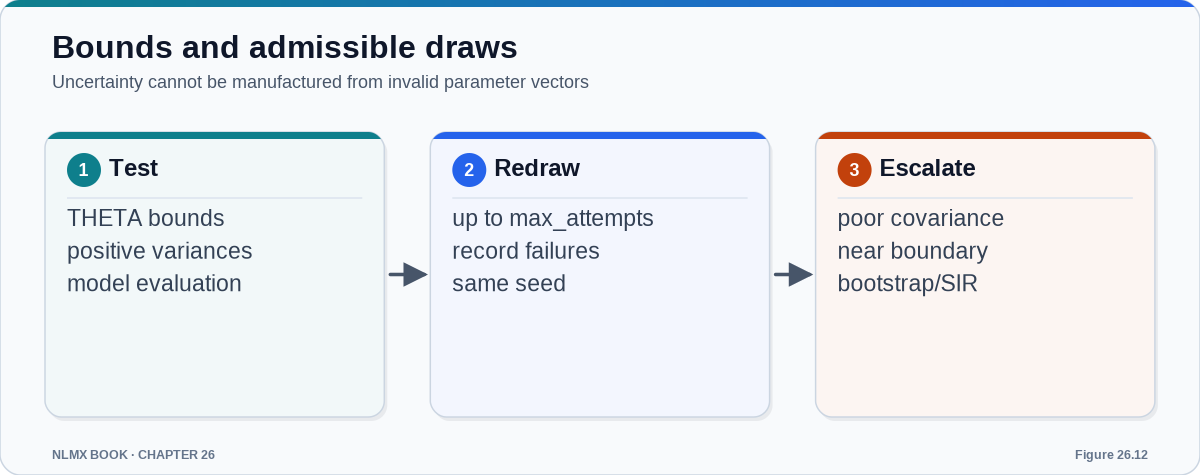
Covariance draws can violate $THETA bounds or create inadmissible model evaluations. nlmx redraws up to max_attempts (default 100) rather than silently clipping, because clipping distorts the uncertainty distribution. Repeated inability to generate valid sets is a failure or a strong warning about the covariance approximation.
Inspect bounds, variance positivity, correlations, transformation, and distance from boundaries. If admissible MVN mass is small, use a better parameterization or empirical parameter sets; do not merely raise attempts until the warning disappears.
Record accepted draw count and source. With --no-uncertainty, interval columns are absent rather than zero-width evidence. Point-only output is useful as a sensitivity but cannot support claims about precision or reference-band classification.
Common mistakes
- Treating a forest ratio or reference-band class as covariate-selection evidence, causality, or an automatic dosing recommendation.
- Omitting the reference subject, uncertainty source, regimen, subgroup denominator, data support, or fitted-model diagnostics.
- Confusing parameter-uncertainty intervals, BSV ranges, and subject-bootstrap intervals because they share one graphic.
Page checklist
- The numerator, denominator, fitted model, covariate settings, and units are explicit.
- The interval source and clinical meaning are distinguished from BSV and selection uncertainty.
- Tables, resolved settings, commands, diagnostics, limitations, and confirmation evidence are retained.