How to read this book: five practical paths
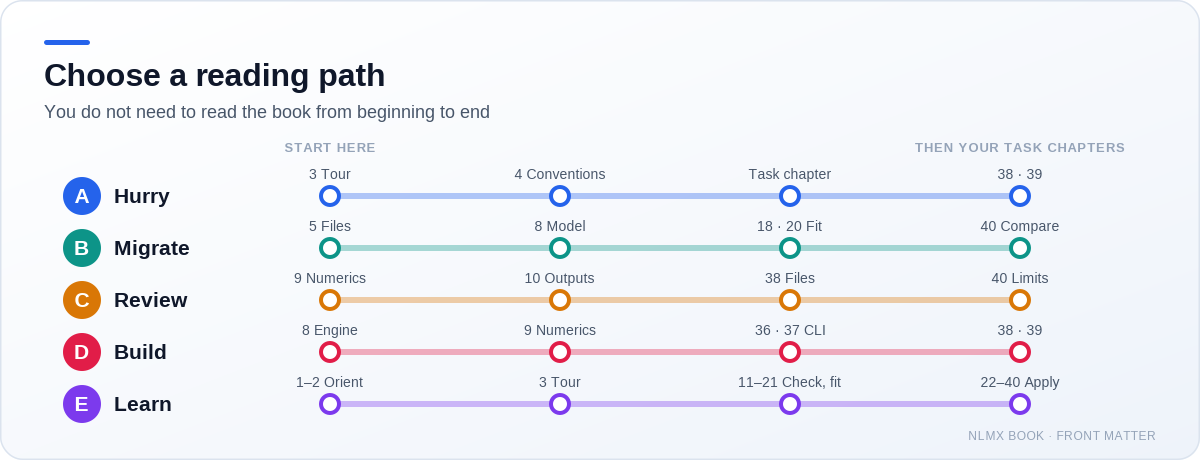
The book is arranged in a logical sequence, but most readers should not read more than a thousand pages linearly before doing useful work. Choose the route that matches your immediate responsibility, then return to the foundations when a decision depends on them.
Path A — analyst in a hurry
Goal: run a defined workflow safely, understand its principal outputs, and know when to stop for help.
- Chapter 43: if you prefer a browser, start with the hosted web apps; every step of the workflow is a form with a live command preview.
- Chapter 3: complete the guided tour in a disposable project.
- Chapter 4: learn output folders, seeds, exit codes, command grammar, units, and missing values.
- Read the overview and complete command/settings index of your task chapter.
- Read that chapter's input, output, warnings, worked example, troubleshooting, and validation pages.
- Use Chapter 38 to identify files and Chapter 39 to triage problems.
Typical destinations are qc-data (Chapter 11), qc-nm (Chapter 12), eda (Chapter 13), custom (Chapter 13A), nca (Chapter 15), fit (Chapter 20), cov/posterior/resume (Chapter 25), forest (Chapter 26), vpc (Chapter 27), sims (Chapter 28), power (Chapter 31), er (Chapter 33), ask (Chapter 35), or report (Chapter 36A).
Shortcut boundary: Skipping theory is acceptable for orientation, not for a decision whose validity depends on that theory. Before reporting model parameters, uncertainty, power, or a covariate conclusion, read the corresponding concept chapter.
Path B — modeller migrating from NONMEM or PsN
Goal: preserve the scientific and numerical meaning of an existing analysis while changing its execution environment.
- Chapter 5: learn which NONMEM files nlmx reads and writes.
- Chapter 8: inspect model parsing, ADVAN/TRANS, ODEs, events, prediction, and likelihood support.
- Chapter 18: align estimation objectives and approximations.
- Chapter 20: run and qualify
fit, including retry behavior. - Chapter 36: use the complete command reference rather than translating from memory.
- Chapter 40: apply the comparison layers, migration pages, unsupported-feature inventory, and benchmark gate.
Begin with a small sentinel model that exercises the same dose/event type and parameterization. Compare frozen-parameter predictions and objectives before comparing optimized estimates. Separate constant objective offsets, parameter transformations, stochastic variation, and true implementation discrepancies. Do not silently remove an unsupported control record.
For covariate workflows, add Chapters 22–25. “SCM” is not one universal algorithm: align relationship forms, candidate scope, thresholds, degrees of freedom, search direction, refit rules, failure policy, and final-model confirmation.
Path C — reviewer or validator
Goal: establish traceability from intended use and requirements to controlled evidence and disposition.
- Chapter 9: numerical core, randomness, determinism, parallel execution, and tolerances.
- Chapter 10: reports, figures, tables, manifests, and publication QC.
- Chapter 18: estimation target and approximation.
- Chapter 38: output-file inventory and provenance.
- Chapter 39: errors, warnings, root-cause workflow, and escalation.
- Chapter 40: known limits and cross-software comparison contracts.
- Planned: Chapter 42, Validation and testing, and Appendix D, Developer guide.
Until Chapter 42 is written, use the matching source release's automated tests, DATA_TEST/, CFR_VALIDATION/, changelog, command schemas, and method-specific validation pages. A planned chapter is not evidence. Review the installed artifact and retained run, not only this book.
A reviewer should be able to answer: What was intended? Which requirements apply? Which version ran? Were inputs immutable? What was independently expected? Which tolerances were justified before seeing results? Which warnings or deviations occurred? Who approved the disposition? What residual risk remains?
Path D — developer or maintainer
Goal: change implementation or documentation without breaking a scientific, numerical, or evidence contract.
- Chapter 8: model-engine pipeline and supported constructs.
- Chapter 9: numerical algorithms, stability, deterministic streams, and platform differences.
- Chapter 36 and Chapter 37: public CLI and settings contracts.
- Chapter 38: output schemas and downstream consumers.
- Chapter 39: error and warning contracts.
- Chapter 40: compatibility boundaries and qualified comparisons.
- Planned: Appendix D for architecture, extension points, tests, and documentation generation.
Before coding, write the expected behavioral change, affected commands and schemas, backward-compatibility decision, deterministic fixtures, numerical tolerance, and documentation impact. A faster kernel is not complete until it preserves or deliberately versions the relevant results and evidence.
Path E — novice learning the complete workflow
Goal: build an integrated mental model before specializing.
Read the front matter, then proceed in order through Parts I and II (Chapters 1–10). Complete the guided tour before reading every foundation page. Continue through data/model checking (11–13A), NCA (14–15), model building and fitting (16–21), covariates (22–26), evaluation (27), simulation/design (28–31), exposure-response (32–33), assistant workflows (34–35), and the reference chapters (36–40).
Pause after each part and produce a one-page analysis record: question, inputs, command/settings, outputs, principal result, warnings, limitation, and next action. This habit is more valuable than memorising syntax.
Choosing between paths
| If you need to… | Start | Add before a decision |
|---|---|---|
| check a dataset today | 3 → 4 → 11 | 6, study-specific data conventions, independent clinical review |
| fit an existing model | 5 → 18 → 20 | 8, 9, 21, 39, 40 |
| select covariates | 22 → 25 | 18–21, 23/23A/24 for the chosen engine, 26 |
| run a VPC | 27 | 8–10, 18–21, model/data qualification |
| plan sample size or power | 30 → 31 | estimand assumptions, simulation/design sensitivity, decision criteria |
| perform exposure-response | 32 → 33 | endpoint definition, missingness, covariates, clinical interpretation |
| compare with another tool | 40 | relevant method chapter, frozen fixtures, predeclared tolerances |
| validate an installation | 9 → 38 → 40 | source validation assets; planned Chapter 42 |
The spiral rule
Reading is iterative. First pass: learn the vocabulary and run a safe example. Second pass: understand the method and settings. Third pass: challenge numerical behavior, uncertainty, limitations, and cross-software agreement. Fourth pass: freeze the controlled workflow and evidence. Do not wait for perfect theoretical mastery before the first synthetic example, and do not let a successful synthetic example substitute for intended-use qualification.
Navigation
See audience and prerequisites, continue to the book map and navigation, or start Chapter 1.