21.1 What diagnostics can—and cannot—establish
Diagnostics test implications of a fitted model against the observed data. If the model says residuals should be centered, approximately unstructured over time, and appropriately scaled, a systematic departure is evidence against some part of that specification. Diagnostics can reveal structural bias, residual-variance mismatch, missing time dependence, subgroup differences, influential subjects, implausible random effects, and weak individual information.
They cannot prove that the model is true. Many models can describe the same observed range, and a flexible random-effects structure can conceal population misspecification. A model can fit measured concentrations while extrapolating poorly to another dose, population, schedule, or endpoint. Diagnostic conclusions must therefore be tied to the intended use.
Separate five questions:
- Eligibility: Were the intended rows, subjects, endpoints, and events used?
- Population description: Does PRED reproduce central trends across time, dose, and covariates?
- Individual description: Does IPRED capture within-subject profiles without implausible ETAs?
- Error behavior: Are residuals centered, appropriately scaled, and free of important patterns?
- Parameter support: Are shrinkage, boundaries, uncertainty, correlations, and conditioning acceptable?
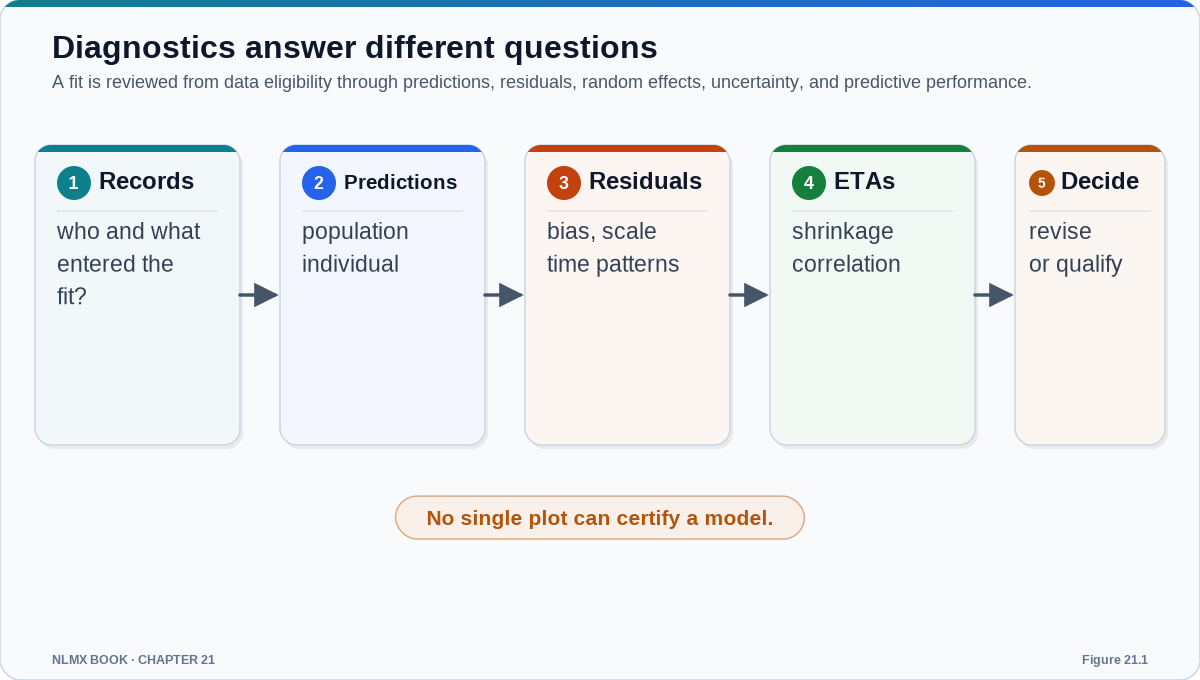
The fifth question is often omitted from “goodness of fit,” yet it matters. Clean residuals do not make a near-singular OMEGA block identifiable. Conversely, a visible but clinically negligible deviation may be acceptable if it does not affect the analysis purpose and is documented.
Before looking at plots, write the acceptance questions. Examples include bias in trough predictions, performance by renal-function group, adequacy at the lowest dose, or stability of individual exposure estimates. This reduces post hoc storytelling.
Common mistakes
- Declaring validation from one attractive DV–IPRED plot.
- Treating absence of a visible pattern as proof of correctness.
- Reviewing only the pooled population when decisions concern subgroups.
- Ignoring parameter uncertainty and boundaries during diagnostic review.
- Using diagnostic findings without recording their consequence.
Checklist
- State the model’s intended use and diagnostic questions.
- Verify eligibility before visual interpretation.
- Review population, individual, residual, and parameter evidence.
- Identify extrapolations not supported by observed data.
- Record accept/revise/qualify decisions for each material finding.
Further reading
Continue with the diagnostic population, the review order, and the final decision framework.