35.13 Every [assistant] and [model] setting
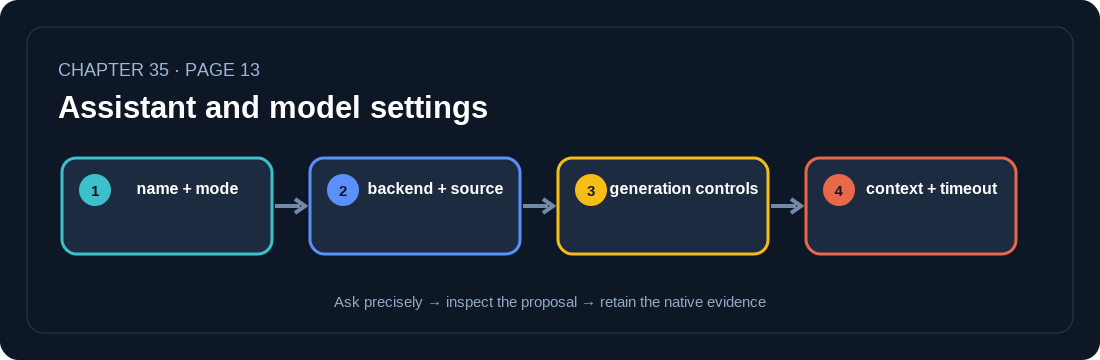
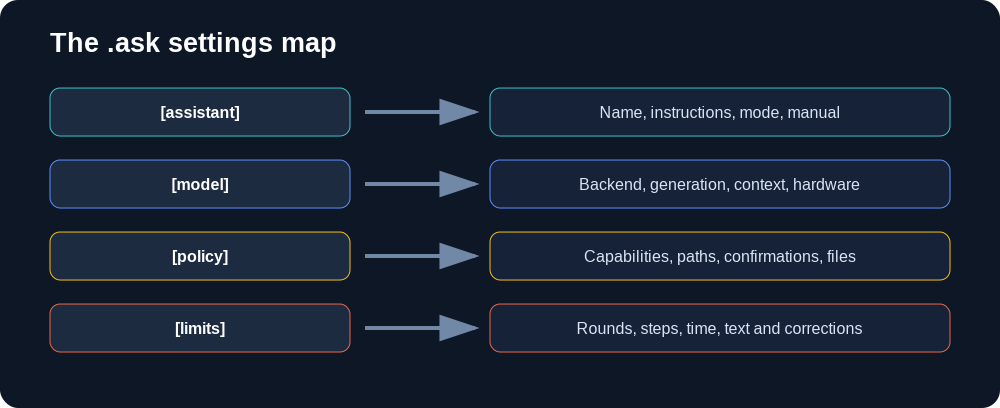
[assistant] controls name (Maxson), optional instructions_file, instructions_mode append/replace, mode auto/guide, and manual=true. Custom instructions alter desired behavior but never policy.
How to use it
[model] controls backend, embedded path, server url and name, mock script, temperature=0.1, max_tokens=768, context=16384, optional CPU threads, gpu_layers="auto", seed=20241024, grammar=true, json_mode=true, and timeout_seconds=600. Backend resolution considers CLI, file, script/path and build availability.
Practical interpretation
Lower temperature usually improves protocol reliability. Max tokens bounds a single reply, not the conversation. Context must hold system prompt/history/new material; history may be trimmed. Grammar constrains embedded replies; server support varies.
How these settings interact
[assistant] name changes the displayed identity; it does not change capability. instructions_file adds site or workflow rules according to instructions_mode; archive that file because it becomes part of the effective prompt. mode controls guide versus auto behavior. manual controls built-in manual context, not whether installed CLI validation occurs.
Within [model], backend determines which of path, url/name, or script is relevant. Sampling settings (temp, max_tokens, seed) influence replies; context bounds available history and retrieved material; threads and gpu_layers influence embedded execution; grammar constrains embedded structured output; json_mode requests server-side JSON formatting; and timeout_seconds bounds a model call. A valid configuration can still be operationally wrong—for example, a server name resolving to an unintended model. Use --print-config to check resolution, then verify runtime identity from logs.
A safe novice workflow
- Start with the narrowest backend, policy, files and command set that can answer the request.
- Name exact inputs and decisions; use guide or plan-only before granting execution.
- Inspect the normalized command and complete settings file, not only Maxson’s explanation.
- Read request end state, native command result, warnings, outputs and checksums.
- Preserve the session and record the qualified person’s interpretation and disposition.
Review and pitfalls
Change one generation control at a time and regression-test. Store instructions alongside the .ask file and archive system_prompt.txt from each session so reviewers know what the model received.
- A session exit code of zero does not prove that every proposal ran or succeeded.
- Model fluency, structured JSON, and policy approval do not establish scientific validity.
- Settings and commands are reproducibility inputs; they still require versioned software and frozen data.
What to retain
Retain .ask, backend/model identity, system prompt, request, raw/normalized replies, transcript, JSONL events, settings versions, commands, child logs/outputs, checksums, exceptions, and reviewer conclusions.
Navigation
See the previous page, next page, and complete ask command and settings index.