16.31 Worked example: sparse pediatric-style sampling
Sparse sampling is where an automatic start generator can be useful but also easiest to overinterpret. This synthetic fixture contains 40 oral subjects with only three post-dose observations per subject. The design resembles a pediatric sparse-sampling problem, but it contains no actual children, covariates, ethical assumptions, or clinical recommendations. It tests computational behavior under limited within-subject information.
Files:
Why NCA is absent
NCA needs enough informative observations to characterise exposure and a terminal phase. With three samples per subject, this fixture does not provide acceptable NCA summaries, so the NCA cells for CL, V, and KA are blank. Blank means the method did not contribute; it does not mean zero. The recommendation therefore combines NLS and ML only.
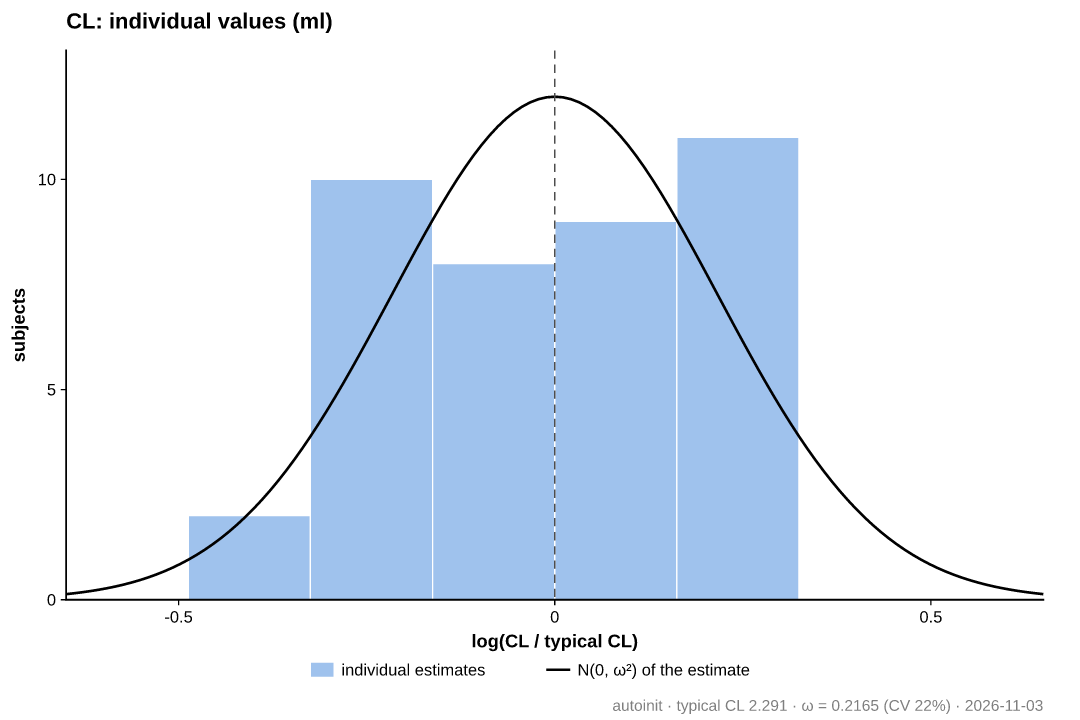
The recommended values are CL/F = 2.291, V/F = 28.274, and KA = 0.986, compared with generating typical values of 2.2, 28, and 1.0. OMEGA comes from shrinkage-corrected ML distributions because those distributions are available even though the N column for recommended parameter rows is zero. The histogram visualises the ML individual-to-typical clearance ratios and their OMEGA overlay. The N field must therefore be read with SOURCE; it is not a universal count of all contributing profiles.
The proportional residual estimate is about 0.410, much higher than in the exact rich-sampling examples. Sparse individual fits cannot cleanly distinguish residual deviation from individual parameter deviation. This is a warning about weak information, not a reliable measurement of assay or model error.
Responsible use
Use the result as a launch point for a pooled population fit, not as a replacement for that fit. Bring clinically defensible allometry, maturation, renal function, formulation, and between-occasion structure into the population model where appropriate. Examine parameter bounds and convergence from multiple starts. A close result in this controlled fixture does not establish performance for unbalanced age groups, BLQ-heavy data, incorrect sampling times, nonlinear elimination, or sparse absorption-phase coverage.
Common mistakes
- Replacing blank NCA values with zero.
- Calling this synthetic design a validated pediatric analysis.
- Reporting the high residual start as a measured residual CV.
- Inferring covariate relationships from a command that does not estimate them.
- Assuming individual sparse fits are precise subject-specific parameters.
Checklist
- Confirm why NCA was unavailable.
- Identify NLS and ML as the contributing methods.
- Read OMEGA source and
Ntogether. - Treat the residual start as provisional.
- Stress-test the later population fit with alternative starts and structures.
Further reading
See method selection, ML neighbours, OMEGA hierarchy, and known limits.