22.23 Choosing frozen, SCM, posterior, or both
The four --method values use the same declared scope and equations but different evidence.
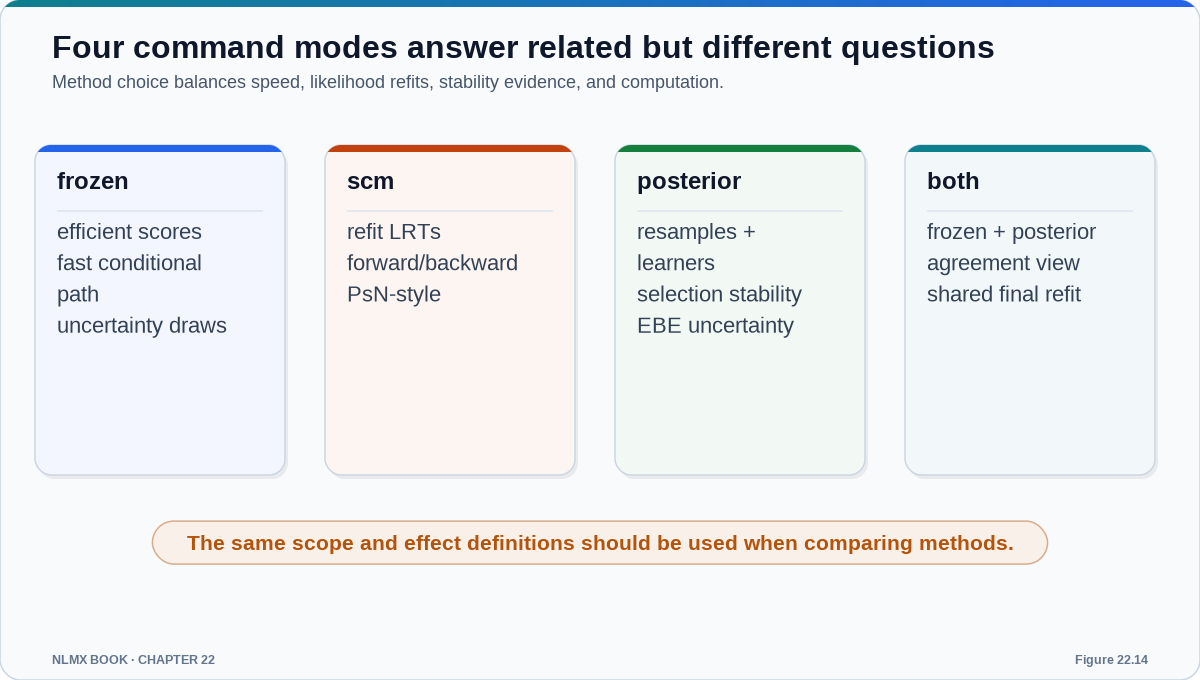
Frozen is the default high-speed method. Efficient score tests evaluate candidates around the base solution, conditional selection builds a set, uncertainty can perturb frozen parameters, and the retained set is jointly refitted. Use it for broad screening, large scopes, expensive models, and a fast first analysis.
SCM refits candidate models and uses likelihood-ratio tests at every forward/backward step. It is closer to traditional PsN stepwise covariate modelling and costs more. Use it for confirmatory stepwise paths, reference comparisons, or when local score approximations may not represent finite effects.
Posterior builds stability evidence from subject posterior information, resamples, parameter draws, and learners. It emphasizes repeatability, sign consistency, and algorithm agreement. Use it when stability under subject/EBE uncertainty is central and PHI/posterior information is adequate.
Both runs frozen and posterior engines for agreement/disagreement evidence. It is not frozen plus SCM. Run SCM separately when required.
All methods normally jointly refit retained effects; --no-final-refit skips this and leaves provisional coefficients/OFV limitations. Compare methods on identical inputs, scope, forms, references, missingness, and seeds where relevant.
Matching the engine to the claim
Frozen screening is attractive when speed and broad candidate coverage matter, provided local approximations are adequate and uncertain terms are escalated. SCM directly answers refit-based forward/backward questions but can be expensive and path-dependent. Posterior stability asks whether signal persists across EBE/posterior uncertainty and resampling; it does not replace likelihood-based confirmation. both supplies complementary frozen and posterior evidence, followed by a joint refit when enabled. State the primary engine before seeing results and define how disagreements will be adjudicated. For a high-impact decision, compare at least one fast approximation with targeted full refits and preserve the computation, thresholds, seed, and executable version.
Common mistakes
- Calling frozen results “SCM” because they have forward/backward steps.
- Assuming
bothincludes refit SCM. - Comparing methods with different scope or feature definitions.
- Selecting the method that retains the preferred covariate.
- Ignoring computational and posterior-data requirements.
Checklist
- Define the evidence question and computational budget.
- Match base model, scope, forms, and policies.
- Use SCM explicitly for refit stepwise testing.
- Interpret posterior stability under its resampling design.
- Refit and diagnose every proposed final model.