32.22 Covariates, adjustment, selection, and interpretation
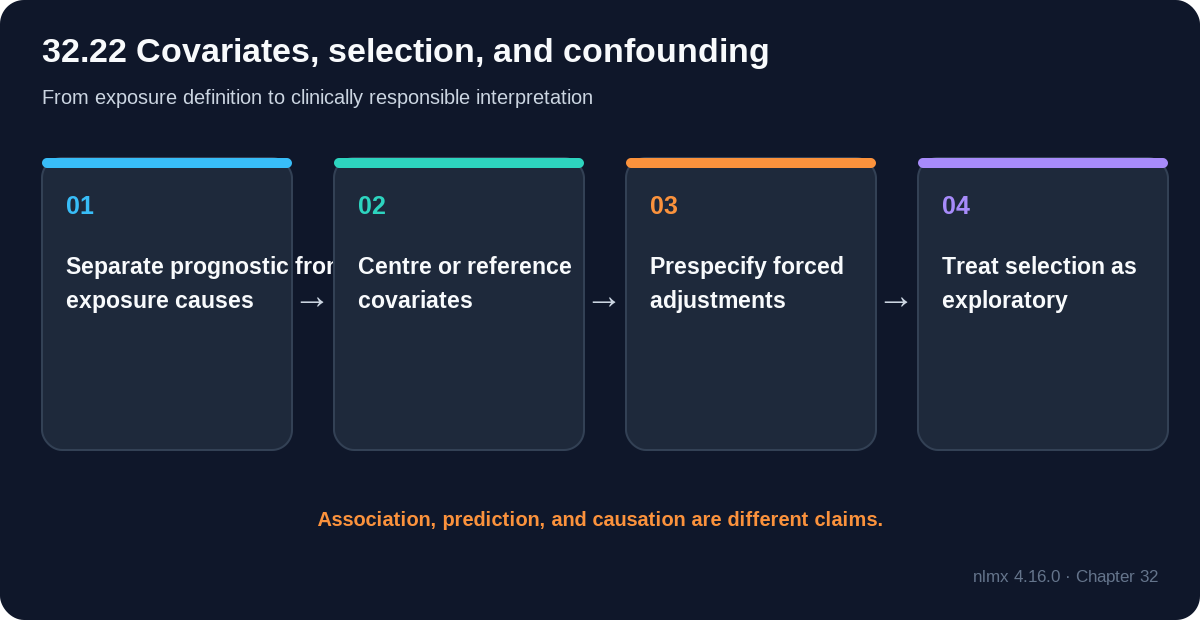
Covariates may improve precision and address prespecified confounding, but data-driven selection changes the estimand and adds selection uncertainty. nlmx centres continuous covariates and indicators categorical levels; forced covariates remain in every model.
Core concepts
- Prognostic covariates predict outcome; PK covariates may predict exposure; common causes are potential confounders.
- Forward/backward likelihood-ratio selection is exploratory and can miss real effects with small samples or events.
- Do not adjust for postbaseline mediators or colliders without causal justification.
Keep five layers separate: the dose assignment, the individual exposure, the endpoint definition, the statistical estimand, and the clinical decision. A fitted curve connects exposure and endpoint within the analysed data; it does not automatically identify the effect of changing dose or exposure in another population.
Worked interpretation
In ordinal analysis, SEX entered forward at p=0.037 but left backward because the default removal threshold is 0.01. This is algorithm behavior, not proof of no sex effect.
A disciplined adjustment strategy
Build the primary adjustment set from causal and clinical knowledge before looking at E–R p-values. Force essential baseline prognostic factors and confounders; use exploratory selection only for secondary objectives. Continuous covariates should have stated units, centring values, functional forms, and missing-data rules. Categorical covariates require explicit reference levels and adequate cells.
Stepwise likelihood-ratio selection repeatedly conditions on the observed data. Nominal entry/removal p-values do not preserve ordinary Type I error, and final SEs ignore selection. Exposure effects can change when correlated covariates enter or leave, so retain a complete step log and compare prespecified full, reduced, and unadjusted models.
Check positivity: every relevant covariate stratum should contain meaningful exposure variation. Check collinearity and parameter stability, not only significance. Never interpret a removed covariate as “no effect.” Do not adjust automatically for postbaseline dose reduction, adherence, toxicity, or response; these may be mediators or colliders and change the causal question.
For a novice, translate every coefficient back to the endpoint scale. Name the starting exposure, ending exposure, predicted outcome at both, contrast, interval, and observed support. For categorical or survival endpoints, also show absolute probabilities or survival estimates because odds and hazard ratios can be hard to interpret clinically.
Quality control and scientific review
Prespecify mandatory adjustments, assess collinearity and positivity, report every selection step, and run sensitivity models.
Review sample size alone only after checking events, category cells, visit counts, placebo support, exposure overlap, exclusions, and missingness. A statistically precise curve can still be clinically irrelevant, confounded, extrapolated, or based on an endpoint definition that does not match the intended estimand.
Common mistakes
- Using stepwise selection to discover causal structure
- Interpreting omitted covariates as absent effects
- Treating a significant exposure term as proof that the selected shape or causal story is correct
Evidence to retain
- exposure definition, window, units, derivation, estimation uncertainty, and distribution by arm;
- endpoint derivation, time origin/visit, analysis population, missing/censoring rules, and exclusions;
- candidate models, covariate rationale, contrasts, selection criterion, diagnostics, failed/unstable fits;
- effect estimates with intervals, observed range, sensitivity analyses, software version, settings, and checksums.
Navigation
See the previous page, next page, and model and estimand catalogue.