22.29 Multiplicity adjustment and score-test calibration
Multiplicity arises from many parameter–covariate pairs, alternative forms, categorical coefficients, conditional steps, and data-driven model comparison. Adjustment addresses one part of the risk but does not eliminate selection bias.
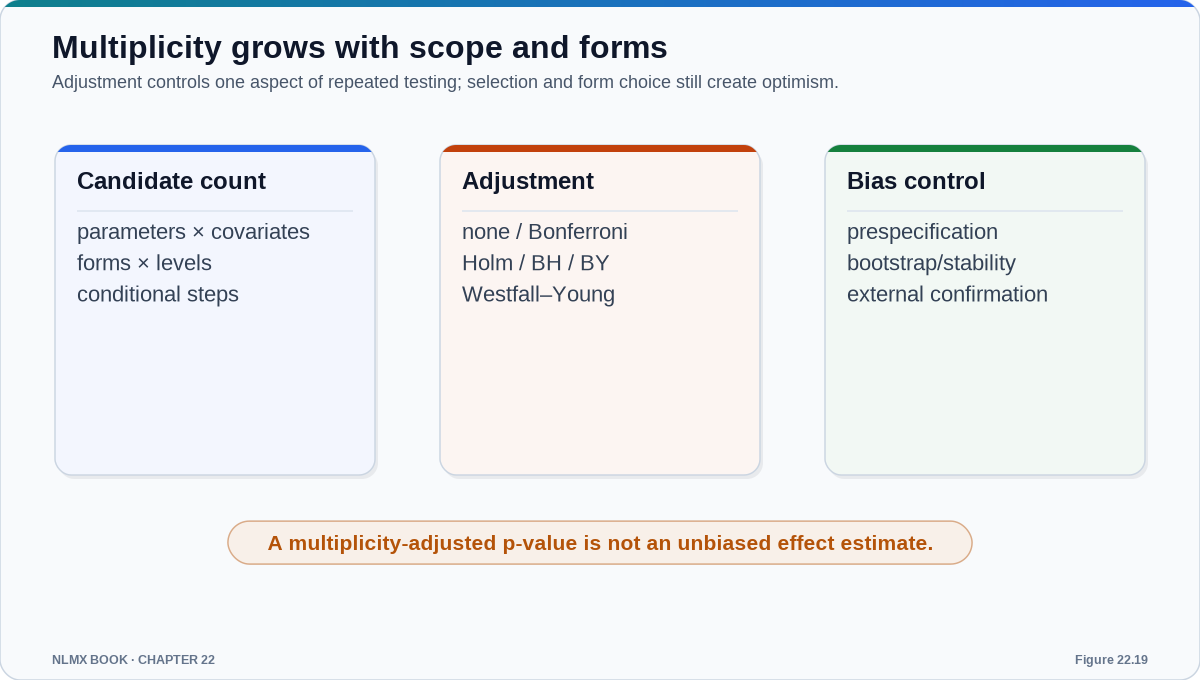
Frozen options include none, Bonferroni, Holm, Benjamini–Hochberg (bh), Benjamini–Yekutieli (by), and Westfall–Young. Family-wise procedures control false positives more strongly; FDR-oriented procedures address expected false discovery proportion under assumptions. Choose the family and objective prospectively.
Score calibration can use none, permutation, or parametric bootstrap with a declared replicate count. Calibration evaluates finite-sample null behavior but adds computation and inherits simulation assumptions. Westfall–Young uses resampling dependence to adjust across candidates.
SCM traditionally uses stepwise LRT thresholds rather than a single global multiplicity correction. Repeated conditional testing and form search still create optimism. Posterior stability uses selection frequency thresholds but also depends on scope and tuning.
Report unadjusted and adjusted/calibrated evidence where available, the candidate family, forms, and thresholds. Do not compare a BH-adjusted frozen p-value directly with an SCM step p-value without context.
Choosing error control deliberately
Multiplicity increases with parameter–covariate pairs, alternative forms, levels, directions, and repeated exploratory reruns. Bonferroni and Holm control family-wise error under broad conditions but may be conservative; BH and BY target false-discovery behavior; Westfall–Young uses resampling to reflect dependence when implemented with sufficient replicates. Permutation and parametric-bootstrap calibration address the null distribution of test statistics, not the scientific plausibility of candidates. Define the family of hypotheses before analysis and report both raw and adjusted evidence. Calibration must preserve the design and relevant dependence structure. For qualification, simulate null and alternative scenarios that resemble the intended data and verify empirical type-I error and power.
Common mistakes
- Claiming multiplicity is solved by one adjusted p-value.
- Choosing the adjustment after seeing results.
- Ignoring form-selection multiplicity.
- Using too few calibration replicates for stable tail probabilities.
- Comparing evidence scales from different methods directly.
Checklist
- Define the candidate family and error objective.
- Prespecify adjustment/calibration and replicates.
- Report raw and adjusted evidence with scope.
- Account for form and stepwise selection.
- Confirm selected effects with refit and stability evidence.
Further reading
Continue with selection bias, scope, and Chapter 23 calibration theory.