17.10 Michaelis–Menten and QSS TMDD candidates
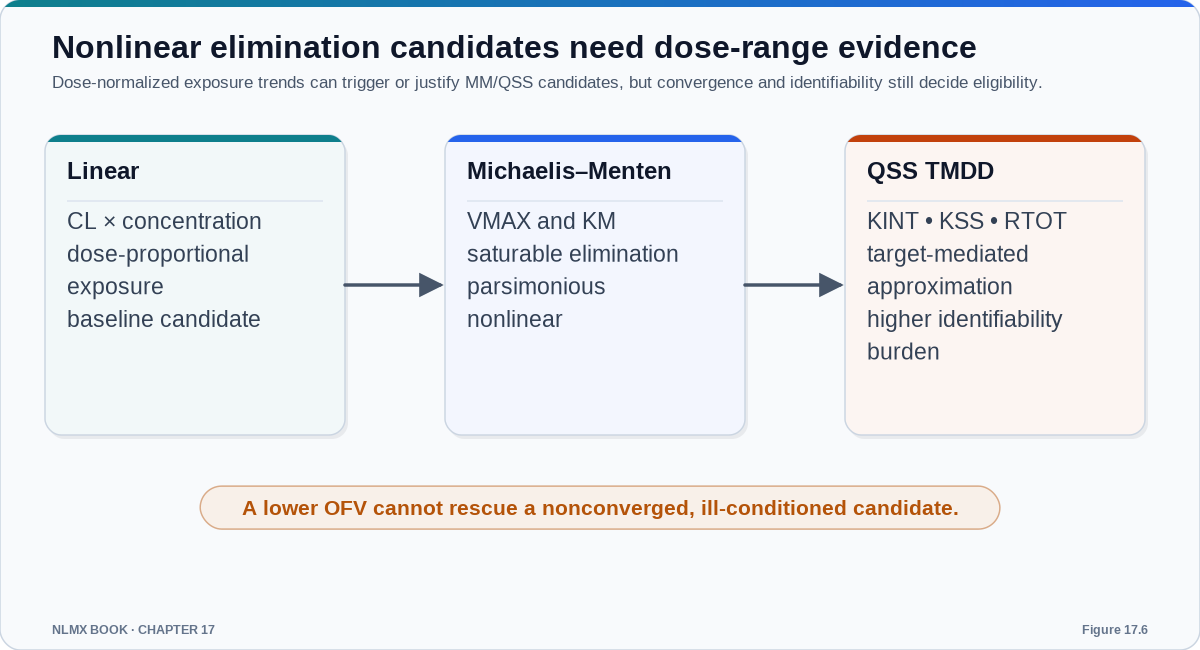
Linear elimination removes drug at a rate proportional to concentration. Michaelis–Menten (MM) elimination adds VMAX and KM: at low concentrations it behaves approximately linearly, while at high concentrations the elimination rate approaches VMAX. A quasi-steady-state target-mediated drug disposition (QSS TMDD) approximation adds a mechanistic target-binding representation, commonly involving KINT, KSS, and total target RTOT.
Use --tmdd no, mm, qss, both, or auto. Automatic inclusion uses dose-proportionality evidence; explicit inclusion is preferable when the analysis protocol already specifies the question. These candidates need multiple exposure levels with overlap in relevant concentration ranges. Dose groups must not be completely confounded with formulation, route, population or calendar effects.
MM is more parsimonious and can capture saturable clearance without claiming a target mechanism. QSS may be scientifically attractive but creates a heavier identifiability burden. A large OFV improvement does not establish target mediation.
In the frozen nonlinear example, the QSS candidate has the lowest OFV and BIC, yet it is nonconverged and has a condition number near 24,045, so it is ineligible. The eligible MM candidate is recommended. The summary explicitly preserves the passed-over QSS improvement, prompting manual follow-up rather than hiding it.
Common mistakes
Do not infer nonlinearity from dose-normalized exposure when dose groups differ systematically, or identify QSS parameters without concentration support near the nonlinear region. Never promote a nonconverged candidate because its OFV is spectacularly low.
Checklist
- Plot exposure and concentration by dose on comparable scales.
- Verify dose groups and route/formulation balance.
- Compare linear, MM and QSS candidates under one likelihood.
- Review convergence, conditioning, precision and parameter plausibility.
- Treat mechanism claims as external to criterion ranking.
Further reading
Continue to automatic TMDD triggering and the nonlinear worked example.