23.14 OPG information: the default
The outer-product-of-gradients estimator builds information from per-subject score vectors. For score vector gᵢ, OPG information is approximately Σᵢ gᵢgᵢ′. Candidate, nuisance, and cross blocks are assembled consistently from subject contributions, then nuisance adjustment uses their Schur complement.
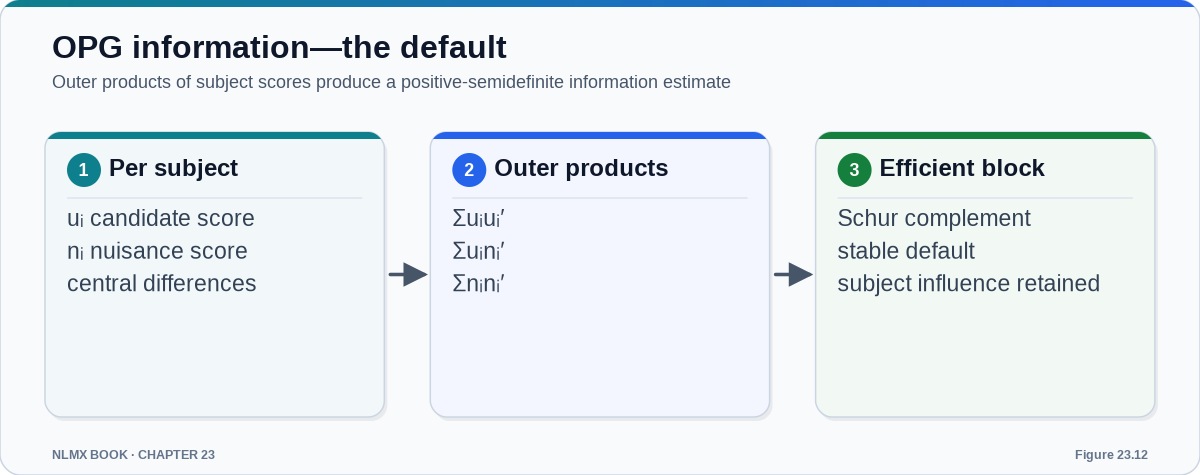
OPG is the default because its full information matrix is positive semidefinite by construction and because it retains the dependence structure between candidate and nuisance subject scores. In the implemented engine, it avoids the specific observed-Hessian candidate–OMEGA behavior that can inflate the adjusted statistic when a covariate explains a large fraction of an ETA's variability.
OPG is not infallible. Finite samples can make it noisy, sparse categories can create rank deficiency, influential subjects can dominate outer products, and misspecification can separate expected and observed information. Review eigenvalues, rank, adjustment fraction, and subject contributions. Calibration or targeted refits may be needed when asymptotic evidence is important.
Use --information-estimator opg explicitly in qualification scripts even though it is the default; that prevents a future configuration or interface change from being mistaken for the validated method.
Reading OPG influence
Because OPG is a sum of outer products, a subject with a very large score can contribute disproportionately to both the numerator and information. Inspecting only the total statistic can hide this. Rank subjects by absolute candidate score, review their profiles and covariates, and recompute a prespecified leave-one-out or robust sensitivity when one subject dominates. Do not delete a subject merely because it is influential: determine whether the contribution reflects an error, a rare but valid covariate region, or genuine information. Transportability may be weak when most evidence comes from a small extreme group even if the statistic is numerically stable.
Common mistakes
- Calling OPG automatically unbiased or exact.
- Ignoring subject influence because the matrix is positive semidefinite.
- Assuming PSD guarantees full rank.
- Switching information estimators without labeling a sensitivity analysis.
- Forgetting to preserve subject-score evidence for validation.
Checklist
- Confirm OPG in normalized settings.
- Review subject contributions and effective rank.
- Inspect the nuisance-adjustment fraction.
- Calibrate or refit material borderline results.
- Lock the estimator in qualification commands.
Further reading
Compare observed-Hessian information and rank diagnostics.