Shrinkage and post hoc exposure interpretation
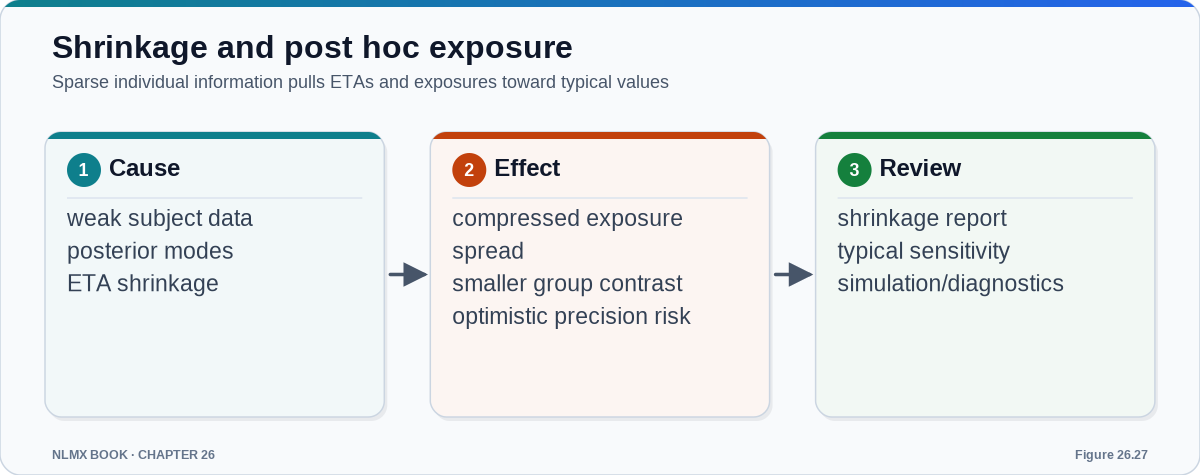
Post hoc ETAs are conditional estimates and inherit shrinkage. Sparse or uninformative subject data pull individual parameters toward typical values, compressing exposure variability and potentially attenuating subgroup contrasts. Bootstrap intervals resample these shrunken estimates; they do not undo shrinkage.
Review ETA shrinkage, individual-information diagnostics, sampling richness, and whether PHI includes the expected subjects/dimensions. Compare post hoc and typical-subject analyses: disagreement can reveal empirical confounding, shrinkage, or structural versus individual-level differences.
Do not claim that a near-unity post hoc subgroup ratio proves no covariate effect when shrinkage is high. Consider simulation, richer individual estimation, or model-based covariate contrasts.
Common mistakes
- Treating a forest ratio or reference-band class as covariate-selection evidence, causality, or an automatic dosing recommendation.
- Omitting the reference subject, uncertainty source, regimen, subgroup denominator, data support, or fitted-model diagnostics.
- Confusing parameter-uncertainty intervals, BSV ranges, and subject-bootstrap intervals because they share one graphic.
Page checklist
- The numerator, denominator, fitted model, covariate settings, and units are explicit.
- The interval source and clinical meaning are distinguished from BSV and selection uncertainty.
- Tables, resolved settings, commands, diagnostics, limitations, and confirmation evidence are retained.