24.4 Posterior source policies
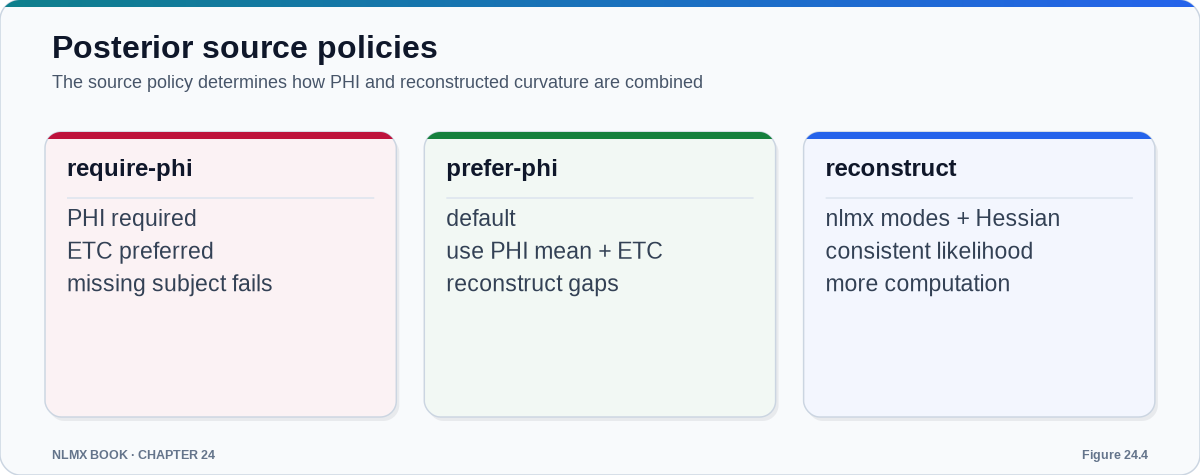
require-phi requires the PHI artifact and refuses missing subject information. It is appropriate when a qualified external PHI/ETC source is mandatory. prefer-phi, the default, uses PHI means and ETC covariance where available and reconstructs missing curvature or subjects. reconstruct computes modes and curvature with nlmx's likelihood for a more internally consistent but potentially slower analysis.
The report counts subjects by source: PHI mean plus ETC, PHI mode plus reconstructed curvature, fully reconstructed, and point EBE only. Mixed sourcing should be reviewed by study and covariate because systematic source differences can become learner signal.
A source choice is not merely an input convenience. External ETC may reflect a different likelihood or numerical method, while reconstruction depends on nlmx support and tolerances. Compare moment consistency, shrinkage, repairs, and selection results across sources when qualification requires equivalence.
Common mistakes
- Assuming
prefer-phimeans no reconstruction ever occurs. - Mixing sources without reporting counts.
- Treating PHI presence as proof ETC covariance is usable.
- Comparing source variants with different candidate scopes.
- Choosing the source that yields more retained terms.
Checklist
- Declare the primary source policy.
- Reconcile subjects, ETAs, and covariance availability.
- Stratify source counts if mixing is systematic.
- Compare posterior diagnostics across source sensitivities.
- Preserve commands and normalized settings.
Further reading
Read PHI and ETC and reconstruction.