35.19 Troubleshooting refusals, settings, context, and sessions
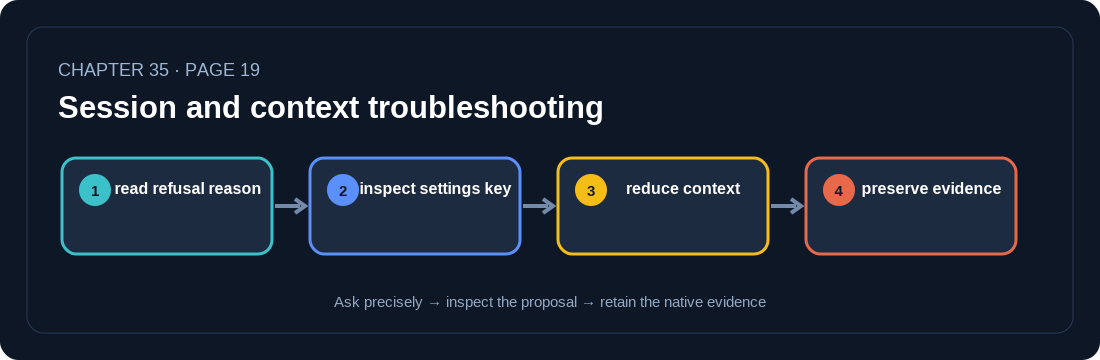
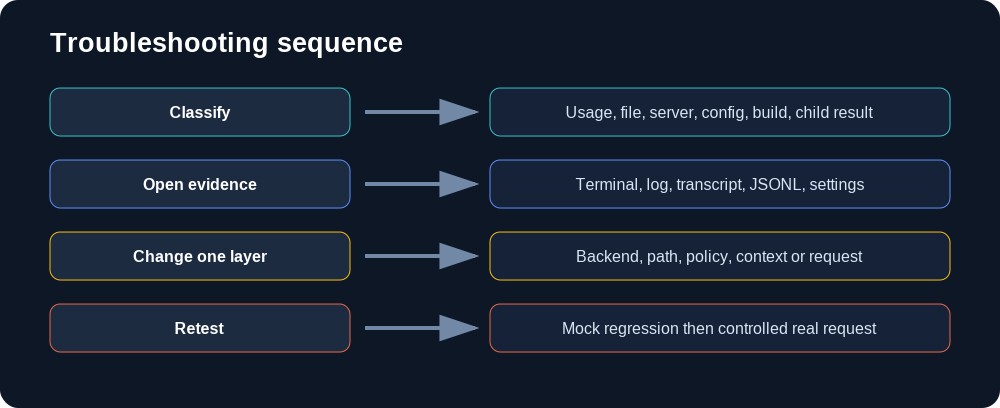
Frequent refusals are diagnosed from exact transcript reasons: missing allowlist command, forbidden option, value cap, path outside roots, remote server, output outside session, invalid syntax or missing required settings. Fix policy only when the action is intentionally authorized.
How to use it
Settings save errors name valid sections/keys. Ask for template COMMAND before retrying. Existing/nonempty session directories are rejected. Several GGUF files select alphabetically unless explicit. Invented options are caught and returned for correction.
Practical interpretation
Since nlmx 4.18.1 a conversation that is too long for context (default 16384 tokens) is shortened before the model is asked: old long replies, old results, files and manual sections go first, then the oldest turns; the instructions, the greeting and the request being answered are kept, and you see one note. If the model still reports that the conversation does not fit, it is shortened further and asked again (at most four times). A model that cannot answer ends the request with its reason and a pointer to ask_log.jsonl, and you can ask again at the you> prompt; a request given on the command line without a terminal still ends with the error and exit code 9. The events unreadable_reply, context_shortened, context_full and request_failed in ask_log.jsonl record these cases. If shortening is not enough, use a model and context that support more, or smaller result/manual limits and shorter conversations. Wrong manual citations improve when the command name is explicit, but must still be checked. Slow or looping replies may require lower temperature, better model, or fewer correction rounds.
Reading a session after something goes wrong
Start with transcript.md for the human sequence, then use ask_log.jsonl for exact event types and structured fields. Compare commands.txt with numbered step folders to see what was merely proposed versus executed. Open the child console and native logs for the original error. Inspect settings_history when a file was revised, and verify checksum manifests before relying on archived evidence.
A policy refusal, operator decline, model question, invalid saved key, child failure, correction-limit stop, step-limit stop, and model timeout are different outcomes with different remedies. Do not label all of them “Maxson failed.” If the response became confused after many turns, restart in a clean session with a concise written specification and the relevant artifacts rather than continuing to accumulate context. A new folder also prevents evidence from two attempts being mistaken for one run.
A safe novice workflow
- Start with the narrowest backend, policy, files and command set that can answer the request.
- Name exact inputs and decisions; use guide or plan-only before granting execution.
- Inspect the normalized command and complete settings file, not only Maxson’s explanation.
- Read request end state, native command result, warnings, outputs and checksums.
- Preserve the session and record the qualified person’s interpretation and disposition.
Review and pitfalls
Preserve the failing session before retrying. A clean new folder makes comparisons possible. Inspect ask_log.jsonl end reason and events rather than assuming outer exit status describes child outcomes.
- A session exit code of zero does not prove that every proposal ran or succeeded.
- Model fluency, structured JSON, and policy approval do not establish scientific validity.
- Settings and commands are reproducibility inputs; they still require versioned software and frozen data.
What to retain
Retain .ask, backend/model identity, system prompt, request, raw/normalized replies, transcript, JSONL events, settings versions, commands, child logs/outputs, checksums, exceptions, and reviewer conclusions.
Navigation
See the previous page, next page, and complete ask command and settings index.