9.7 Ridge stabilization and pseudoinverses
sym_inverse follows an explicit decision path rather than silently forcing every matrix through one method.
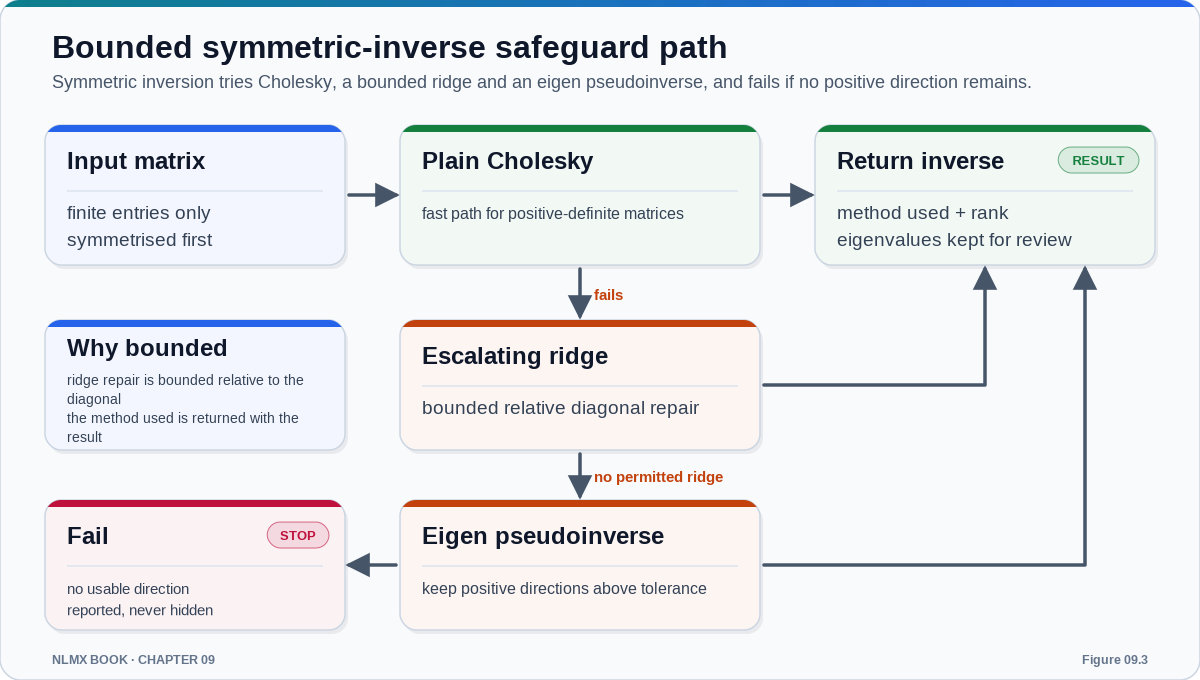
- Reject non-finite entries.
- Symmetrize.
- Try ordinary Cholesky.
- If it fails, compute eigenvalues and scale.
- Add an escalating diagonal ridge and retry Cholesky.
- If no permitted ridge succeeds, invert positive eigen-directions above a relative threshold.
- Fail when no usable positive direction remains.
Table 9.1. Loose stabilization defaults
| Setting | Value |
|---|---|
| Initial relative ridge | 1e-8 |
| Ridge multiplier | 10 |
| Maximum relative ridge | 1e6 |
| Relative eigen/SVD tolerance | 1e-12 |
These LOOSE settings are intended for per-subject conditional curvature during mode search. Other configuration paths construct their own bounds; never advertise one set as universal.
The ridge is relative to max(|largest eigenvalue|, max absolute entry, 1e-300). Every successful ridge or rank-deficient pseudoinverse is debug-logged with eigenvalue context. The returned result identifies method, rank, minimum/maximum eigenvalues and ridge.
Interpretation
A ridged inverse changes the problem. A pseudoinverse drops directions. They may be operationally necessary, but rank loss or a large ridge is scientific diagnostic information about identifiability, curvature or design.
Common mistakes
- Calling a stabilized result the original inverse.
- Using loose per-subject limits as global covariance defaults.
- Ignoring numerical rank in downstream degrees of freedom.
Checklist
- Record method, ridge, rank and eigenvalue range.
- Set maximum repair before the analysis.
- Escalate large repairs for scientific review.
Further reading
See condition and PSD repair, logging diagnostics and Chapter 7's effective settings.