Forward inclusion step by step
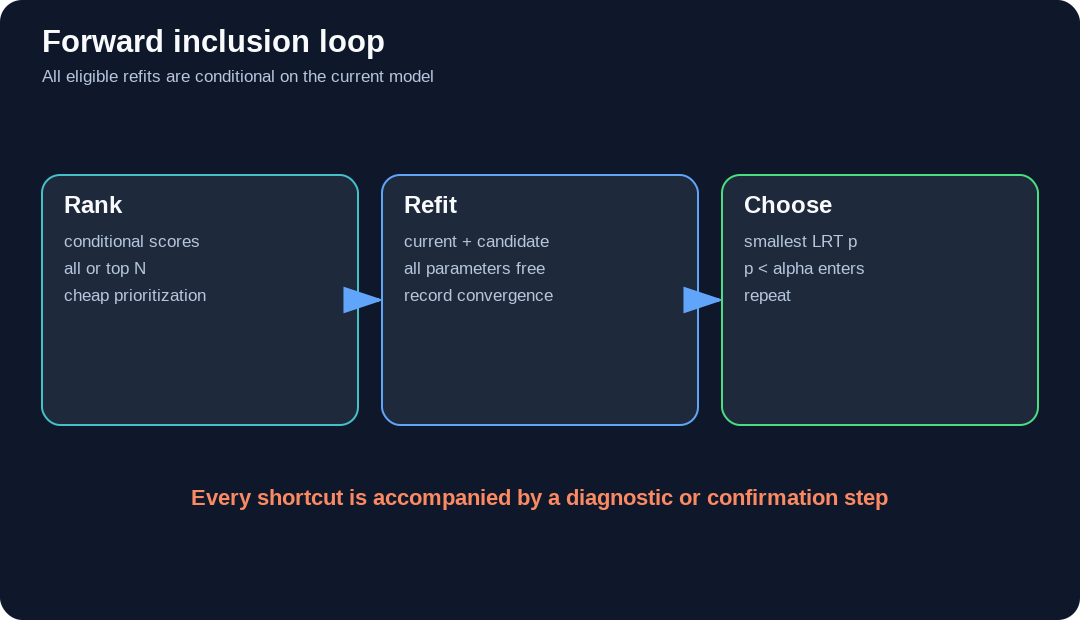
At each forward step nlmx scores the remaining eligible candidates conditionally on the current fit, ranks them, and refits either the best N or all candidates. The actual decision is made from the refitted LRT p-values—not from the preliminary score. Among successfully refitted candidates, the smallest p-value is the proposed winner.
If that p-value is strictly below --alpha (or its alias --p-forward), the relationship enters, the active model changes, and every remaining candidate becomes a new conditional question. If the best p-value is at or above alpha, the forward stage stops. A candidate not refitted because of a positive cap is deferred, not proven unimportant.
Read the trace in sequence: candidate model set, convergence, ΔOFV, df, p-value, chosen addition, and new active set. In the verified full run, V–WT entered first (ΔOFV 40.764), CL–WT second (18.542 conditionally), and CL–EGFR third (15.947 conditionally); the two SEX effects did not cross 0.05.
Common mistakes
- Treating a stepwise p-value as clinical importance or causal proof.
- Reading a candidate comparison without its active model, convergence state, degrees of freedom, and exact threshold.
- Reporting only the terminal relationship list while discarding failed models, path decisions, configuration, and provenance.
Page checklist
- The scientific question, model identities, and comparison direction are explicit.
- Numerical validity is reviewed before interpreting statistical evidence.
- The result is linked to the complete trace and final joint-model diagnostics.