19.21 Multivariate-t proposal and antithetic draws
For subject \(i\), nlmx centers a multivariate t proposal with four degrees of freedom at conditional mode \(\hat\eta_i\). Its scale is \((H_i/2)^{-1}\), the local conditional covariance. If curvature is unusable, OMEGA supplies fallback scale.
Draws are
(\eta=\hat\eta_i\pm L_i z/\sqrt w,quad w\sim\chi^2_4/4.)
The plus/minus antithetic pair balances symmetric sampling and can reduce Monte Carlo noise. Heavy t tails protect against a posterior broader than local normal curvature.
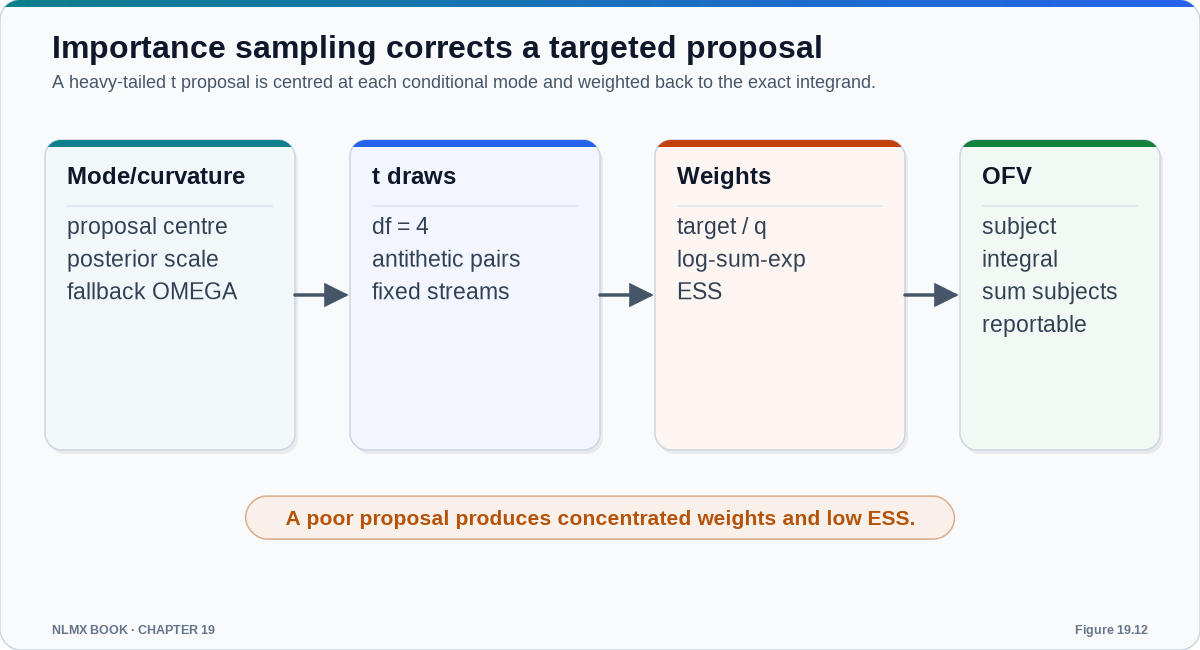
Proposal quality is subject-specific. A mode/curvature approximation can miss multimodality or skewness, causing concentrated weights and low ESS.
Practical interpretation
Verify the univariate t density integrates to one and that transforming standard draws by L produces the intended scale. For every generated (+d), confirm a (-d) partner around the same mode using the same chi-square scale. Odd requested M requires a documented handling rule.
Compare the proposal with target profiles for low-ESS subjects. If the proposal is too narrow, heavy weights appear in tails; if badly centered, one side dominates despite antithetic pairing. More draws help coverage but cannot fully cure a proposal missing a distant mode.
Record whether curvature or OMEGA fallback defined each subject proposal. A high frequency of fallback is itself a diagnostic about conditional geometry.
Validate proposal normalization and transformed density in one and several dimensions, including nearly correlated scale matrices and zero-active-ETA subjects.
Common mistakes
Do not omit proposal density in weights, treat antithetic draws as independent, or use a Gaussian q formula for t draws. Curvature fallback should be recorded.
Checklist
- Recenter at each subject mode.
- Use df=4 t normalization.
- Generate paired draws correctly.
- Evaluate full J and log q.
- Diagnose with ESS.
Further reading
Proceed to log weights and ESS.