29.16 Replicates, seeds, threads, runtime, and failures
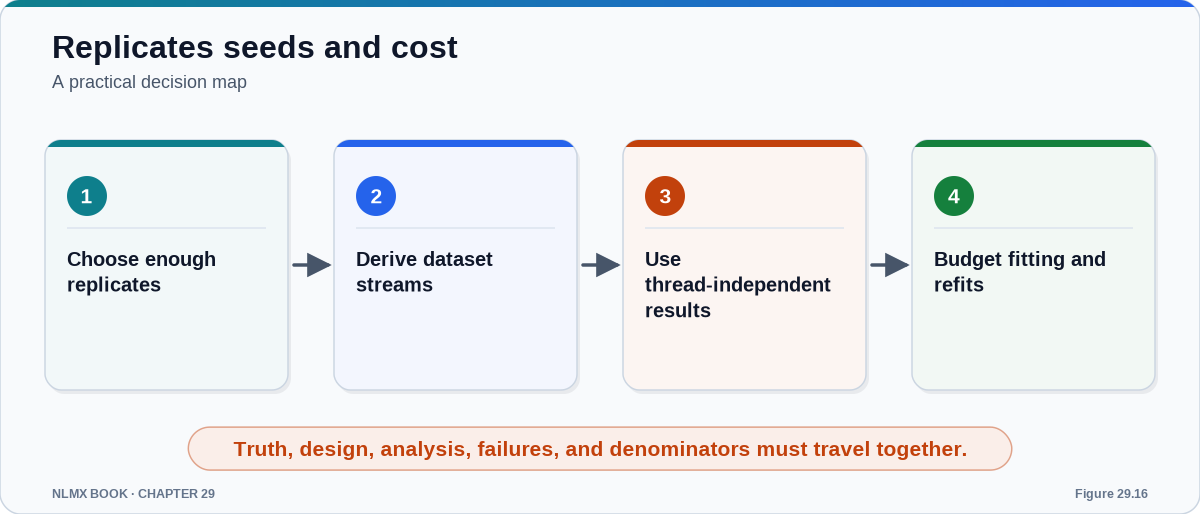
Replicates are executed sequentially by scenario, while each inner fit/engine can use available threads. Runtime therefore grows with scenarios × requested replicates × engines, and SCM adds many refits. A failure can occur during project/base-fit construction or in one engine; successful engines in the same replicate can still contribute rows.
Why this matters
The choice on this page changes either the generated truth, the information available to the fit, the analysis decision rule, or the denominator of an operating characteristic. A novice should be able to point to the corresponding setting and output column. A reviewer should be able to trace every aggregate back to a generated project, completed engine run, and relationship-level row.
Detailed behavior
study_metrics.csvreports completed replicates per scenario/engine, not merely requested replicates.- Thread count should not change deterministic results within nlmx's random-stream design, but version and configuration remain part of identity.
- In nlmx 4.14.3, source inspection and two executed runs show that
simulate-study --seedis not consumed: replicate seeds are fixed from scenario and replicate indices. - Different
--seedvalues 111 and 999999 generated byte-identical analysis.csv files (SHA-256 BFEA9206…BBFB) in the verification runs. - The fixed seed formula includes scenario position, so reordering the scenario list can change the stream used for a named scenario even though
--seedcannot.
Keep four layers separate: design truth defines what was generated; realised data contain finite random variation; fitted artifacts estimate the model from those data; and analysis decisions classify relationships under a method and threshold. Mixing these layers is the most common source of incorrect recovery claims.
Example command or settings fragment
nlmx simulate-study -o study --study-replicates 20 --subjects 100 --threads 8 --seed 12345 # seed currently ineffective in 4.14.3
Begin with an inexpensive smoke run, inspect every generated artifact and warning, and only then increase subjects, scenarios, engines, or replicates. Use a new output directory for each analytical run. In a regulated or validation setting, preserve both the command as issued and the resolved settings or generated configuration because defaults and precedence are versioned behavior.
Interpretation and quality control
Until the implementation changes, reproducibility is version/scenario/replicate-index based and users cannot create independent streams through --seed. Document this limitation and avoid presenting changed seed as an independent Monte Carlo repeat.
At minimum, verify subject/record counts, truth coefficients and forms, fit convergence, covariance status, relationship scope, classifications, completed denominators, and checksums. Read the row-level result before trusting a scenario metric. A graph is a compact diagnostic view; numerical tables remain authoritative.
Common mistakes
- Using requested rather than completed denominators
- Assuming CLI seed changed the study
- Comparing runtimes without model, engines, threads, or failures
Also avoid describing a failed or skipped cell as a zero rate. Missing, undefined, failed, rejected, and uncertain are different states and must remain distinguishable.
Evidence to retain
- nlmx version, command, configuration, seed behavior, threads, and runtime environment;
- generated truth/control stream, data, group/design definition, base and optional covariate fits;
- engine settings, relationship scope, row-level results, summaries, metrics, report, failures, and completed denominators;
- checksums, scripts used to regenerate figures, tolerances, acceptance rules, and scoped interpretation.
Navigation
See the previous page, next page, and complete command and settings index.