19.15 Annealing and positive definiteness
During the first half of burn-in, an OMEGA variance may shrink by at most 5% per iteration: (\omega_{kk}\ge0.95\omega_{kk}^{previous}). This simulated-annealing safeguard prevents rapid variance collapse before chains explore.
If an updated OMEGA is not positive definite, nlmx shrinks off-diagonal elements until it is. This preserves a valid normal prior and Cholesky sampling.
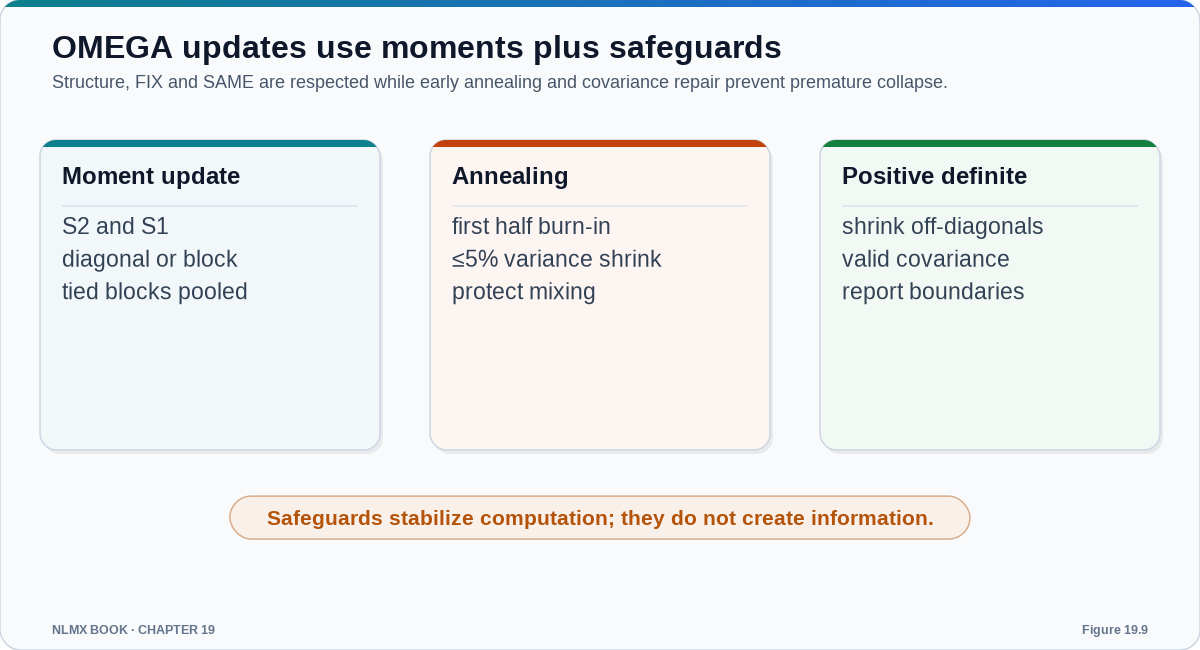
Safeguards bias the immediate update deliberately during transient burn-in. They do not add information or prove final OMEGA estimability. Final boundary/covariance diagnostics still apply.
Practical interpretation
Plot raw moment-based variance proposal and annealed accepted variance. Early separation shows the safeguard working; persistent separation until protection ends suggests chains/statistics are driving collapse. For covariance repair, record pre/post eigenvalues and off-diagonal shrinkage. Frequent repair can signal an unsupported block or insufficient conditional samples.
Validate the half-burn boundary exactly. If burn length is odd or stationarity ends early, document how the implementation defines the protected interval. Safeguards must be deterministic under a fixed seed and preserve FIX/SAME relationships.
Final validation should include a case where no repair is needed, a recoverable indefinite moment update, and a genuinely unsupported covariance. The last should warn or fail rather than being cosmetically repaired forever.
Report final repair-related warnings in the model review even when the ending OMEGA is valid, because repeated transient invalidity can reveal weak information.
Common mistakes
Do not report annealed intermediate OMEGA as final inference, hide repeated repairs, or assume positive definite means well conditioned. A variance can collapse after the protected half.
Checklist
- Apply 5% floor only in first half burn-in.
- Record repair frequency.
- Preserve fixed/tied structure.
- Check final boundaries/correlation.
- Investigate persistent repair needs.
Further reading
Continue to burn-in and Chapter 18 covariance boundaries.