19.13 OMEGA updates and structure
With MU shift vector \(c\), nlmx updates
This centers second moments around population location. Only estimated elements change: diagonal records update diagonals; BLOCK updates all block elements; FIX stays fixed; BLOCK SAME tied elements are pooled by mean.
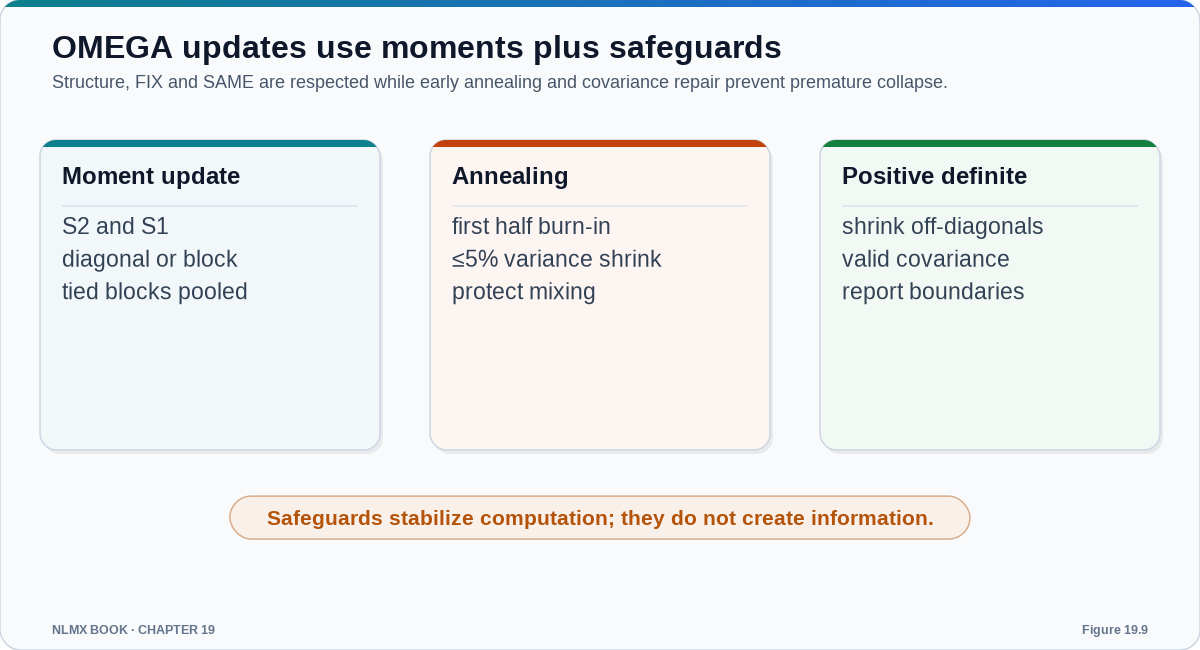
Sample moment noise can temporarily produce unstable covariance. Early annealing and positive-definiteness repair protect the process, as the next pages explain. These safeguards do not demonstrate support for a large block.
Monitor variance traces, correlations and boundaries. Collapsing variance can freeze chain exploration and make later recovery difficult.
Practical interpretation
For a two-ETA block, calculate S1 and S2 from a few hand-written samples, apply the centered formula, and compare with an ordinary sample moment using the same denominator. Then mark which elements would update under diagonal, full block, FIX and SAME specifications. This exercise catches structural bookkeeping errors separate from stochastic behavior.
Track OMEGA on variance and correlation scales. A smooth covariance element can hide correlation racing toward ±1 when a variance shrinks.
For BLOCK SAME, validate pooling with unequal numbers of occasions/blocks and ensure tied elements remain numerically identical after every update. FIX elements must remain bitwise unchanged under the same test.
After accumulation, compare moment-derived OMEGA with empirical conditional samples and the reported matrix. Differences should be explainable by MU centering, structure, ties or safeguards rather than hidden bookkeeping.
Common mistakes
Do not replace S2 directly with OMEGA without centering, break FIX/SAME structure, or average covariance matrices with incompatible ETA ordering.
Checklist
- Verify centered-moment formula.
- Respect diagonal/block/tied structure.
- Check symmetry and positive definiteness.
- Track variance/correlation traces.
- Validate on simulated known covariance.
Further reading
Continue to other parameters and OMEGA safeguards.