Analysis hash and random-stream identity
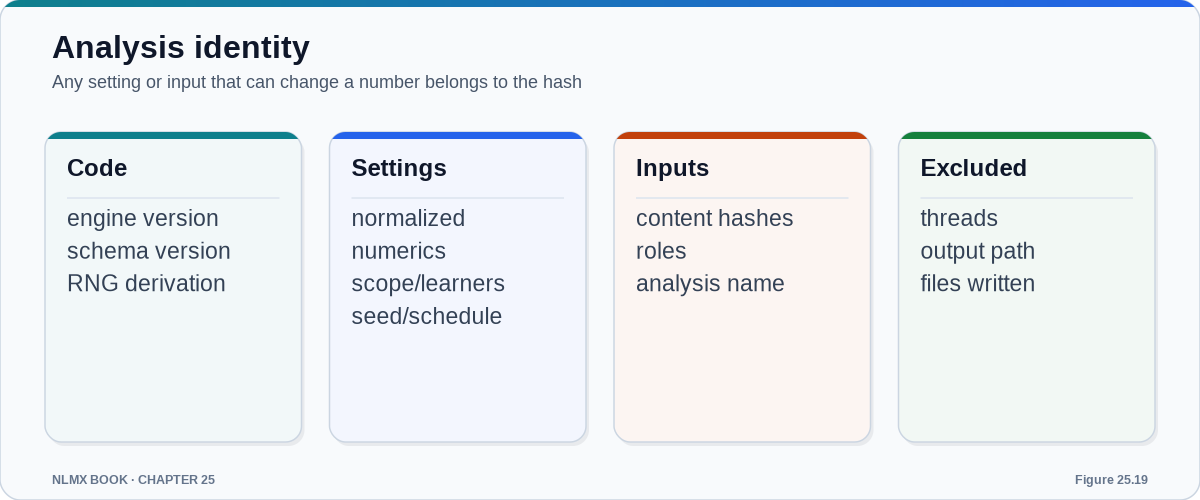
The analysis hash binds engine version, schema version, RNG derivation version, normalized settings that can change numbers, analysis name, learners/primary, seed, replicate design, posterior sampling, variance-consistency method, relationship forms/statuses, and content hashes of all input artifacts. This makes continuation a claim about the same computation.
The settings fingerprint deliberately removes execution and output tables because threads, destination formatting, and files written do not alter numerical results. Everything else is included automatically once represented in normalized configuration; tests verify that folds, mode tolerance/iterations, seed, and OFV tolerance change identity.
Do not treat the short displayed hash as a substitute for archived inputs and configuration. It is a compatibility gate, while manifests/checksums are human-auditable provenance. Any engine/schema/RNG version mismatch is refused because continuing could mix random-stream definitions or state layouts.
Common mistakes
- Changing the scientific question after seeing the result while presenting it as the original run.
- Reading one engine's summary without checking its prerequisites, failures, normalized settings, and fitted endpoint.
- Treating a generated draft, comparison label, or completed checkpoint as a substitute for model diagnostics and reference-software confirmation.
Page checklist
- The exact command, version, inputs, resolved settings, and output directory are identifiable.
- Engine-specific evidence is interpreted on its own scale before cross-method comparison.
- Recovery state, final refit, diagnostics, and remaining confirmation work are explicit.