14.3 Numerical integration foundations
The true area under a continuous concentration curve is an integral. NCA observes only discrete samples, so it constructs an assumed curve between adjacent points and integrates that curve segment by segment.
For times t₁<t₂ with concentrations C₁ and C₂, define Δt=t₂−t₁. Total area is the sum of segment areas. The method must also define concentration at an interior boundary for partial AUC or τ; consistent implementations use the same linear or exponential interpolation as the area rule.
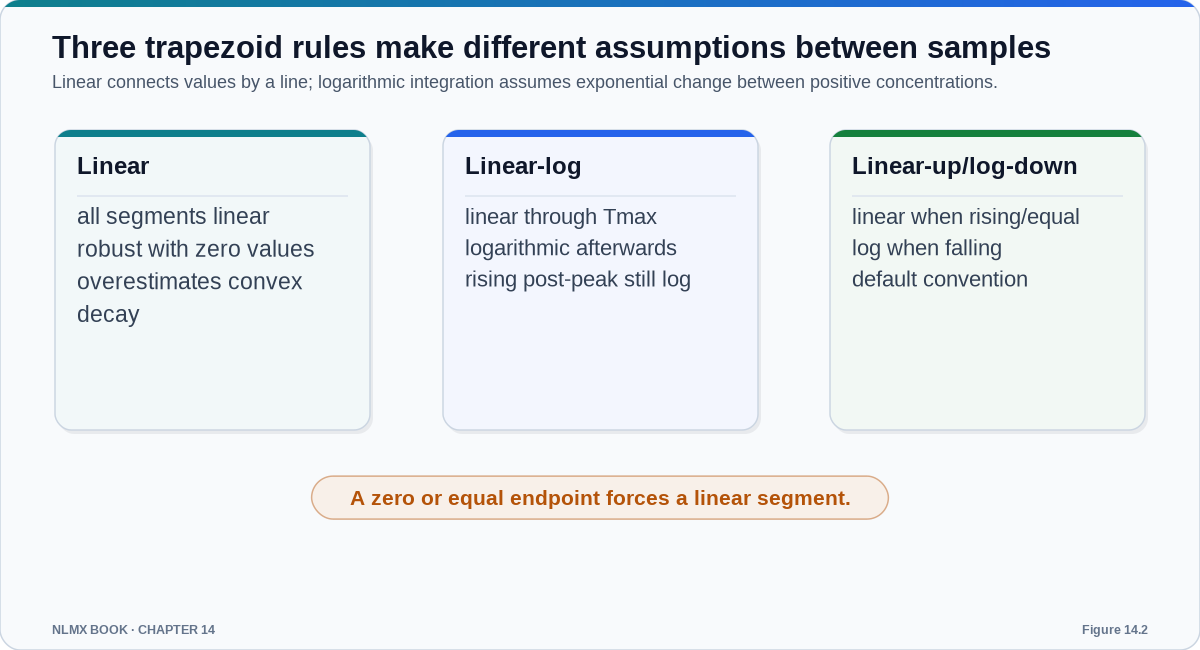
Why rules differ
A straight line between samples creates a linear trapezoid. Exponential change creates a logarithmic trapezoid. During absorption, concentration often rises non-exponentially; during terminal decline, exponential interpolation may be closer. No rule knows the unobserved curve, so sampling density controls approximation error.
The linear rule overestimates the area under a convex exponential decay. Logarithmic integration is exact for a perfect exponential between positive endpoints, but cannot operate through zero and may be inappropriate for rising or irregular data.
Start and end
An extravascular first-dose or infusion curve may add zero at dose time. An IV bolus may add back-extrapolated C0. Later-dose profiles can start at their first sample rather than add area before it. Tlast is the last measurable point after data rules, not necessarily the scheduled final visit.
Common mistakes
- Treating the trapezoid name as a cosmetic software option.
- Interpolating a partial boundary differently from its segment rule.
- Assuming denser sampling eliminates all bias.
- Ignoring an inserted zero or C0 in AUClast.
Checklist
- Plot every point and added boundary.
- State the segment rule.
- Recalculate several segments manually.
- Review gaps around peaks and terminal decline.
- Compare rules as a sensitivity analysis when consequential.
Further reading
See linear trapezoids, log trapezoids, and linear-up/log-down.