24.26 Multivariate sparse-group learning and OMEGA whitening
The multivariate learner models all ETA outcomes jointly. OMEGA whitening accounts for scale and correlation among random effects, and sparse-group penalties can favor relationships shared across outcomes while retaining outcome-specific structure.
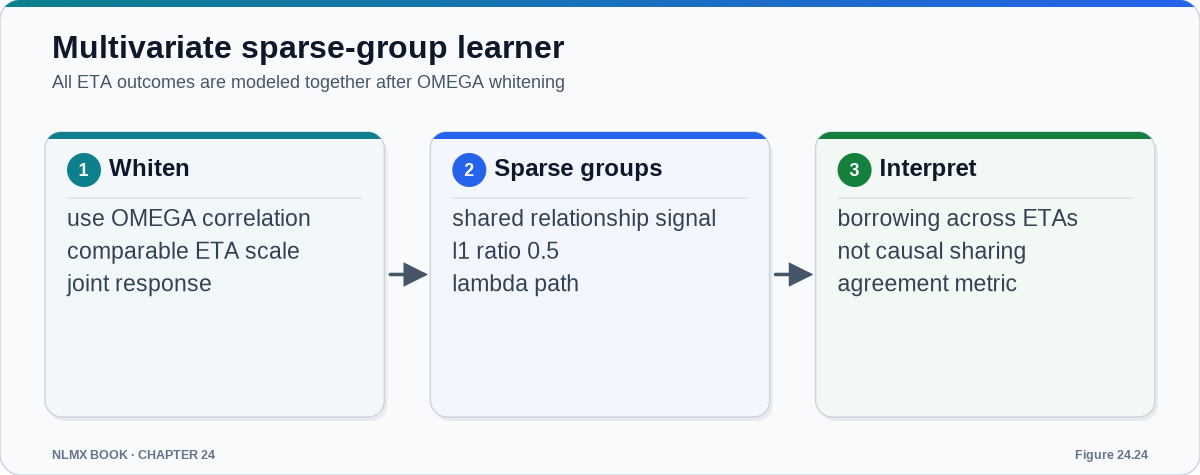
Defaults include L1 ratio 0.5, 30 lambda values, and minimum-CV selection. The method can borrow strength when one covariate affects several parameters, but it can also propagate misspecification or OMEGA errors across outcomes. A shared selected group does not mean the effect magnitude or equation is identical on every parameter.
Compare multivariate probability with per-ETA learners and inspect OMEGA conditioning. Treat large disagreement as a diagnostic.
Common mistakes
- Assuming joint selection implies equal coefficients.
- Whitening with an incompatible OMEGA.
- Ignoring outcome-specific signs.
- Calling borrowing of strength independent replication.
- Reporting penalized multivariate coefficients as final.
Checklist
- Verify OMEGA labels, scale, and conditioning.
- Record penalty path and selection rule.
- Review parameter-specific coefficients/signs.
- Compare with univariate learners.
- Confirm joint effects in the population model.
Further reading
See learner agreement and Chapter 18's OMEGA discussion.