17.25 best_model.ctl and prepared data
best_model.ctl is the recommended model rendered with final estimates as starting values. It is a continuation artifact: inspect, version, and refit it; do not mistake copied final values for an independently confirmed model. Check $INPUT, $DATA, dose compartments, route, scaling, parameter bounds, OMEGA/SIGMA blocks, estimation and covariance records, and requested tables.
The output data/ area preserves prepared analysis data and related evidence. Compare its checksum and counts with the summary. If the control stream references a relative file, keep the directory relationship intact or update the path explicitly. A control stream separated from its prepared data can silently fit a different dataset.
Candidate-specific fit artifacts may exist under a candidate-results area. They support forensic review of listings, tables and reports. Chapter examples deliberately rely on top-level comparison evidence for the main narrative; a real pivotal analysis should inspect the selected candidate’s full fit diagnostics.
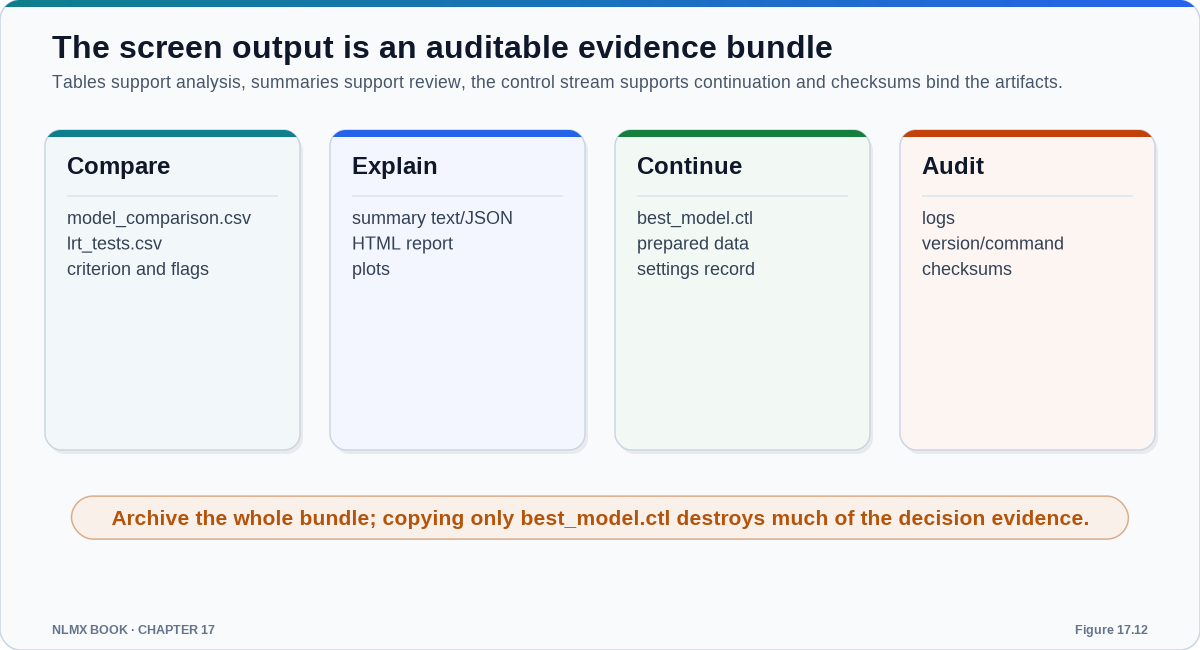
Archive the entire screen bundle, not only best_model.ctl. The comparison table, settings, summaries, plots, log and checksums explain why that file exists. When you edit it for the next stage, make a new tracked file and record the change.
Perform a clean-room reproduction before extending the model: copy the archived bundle to a controlled location, run the generated control stream with the recorded executable/settings, and compare objective, estimates and covariance under tolerances. This detects hidden path, environment or generated-file dependencies early.
Common mistakes
Do not overwrite the generated control stream, point it at the raw rather than prepared dataset, or assume final screen estimates will reproduce under changed estimation settings. Relative paths can break when only one file is copied.
Checklist
- Diff the control stream against the reported candidate.
- Confirm data path, counts, checksum and filtering.
- Verify units, scaling, route and parameterization.
- Refit under recorded settings before extension.
- Preserve the original bundle read-only.
Further reading
See Chapter 20 for fit, settings and paths, and reproducibility.