16.13 OMEGA estimation, source hierarchy, and floors
Autoinit proposes OMEGA variances for CL, V/V1, and KA. They are starting values on the log-parameter scale. OMEGA_CV_PCT is the corresponding approximate lognormal CV presentation.
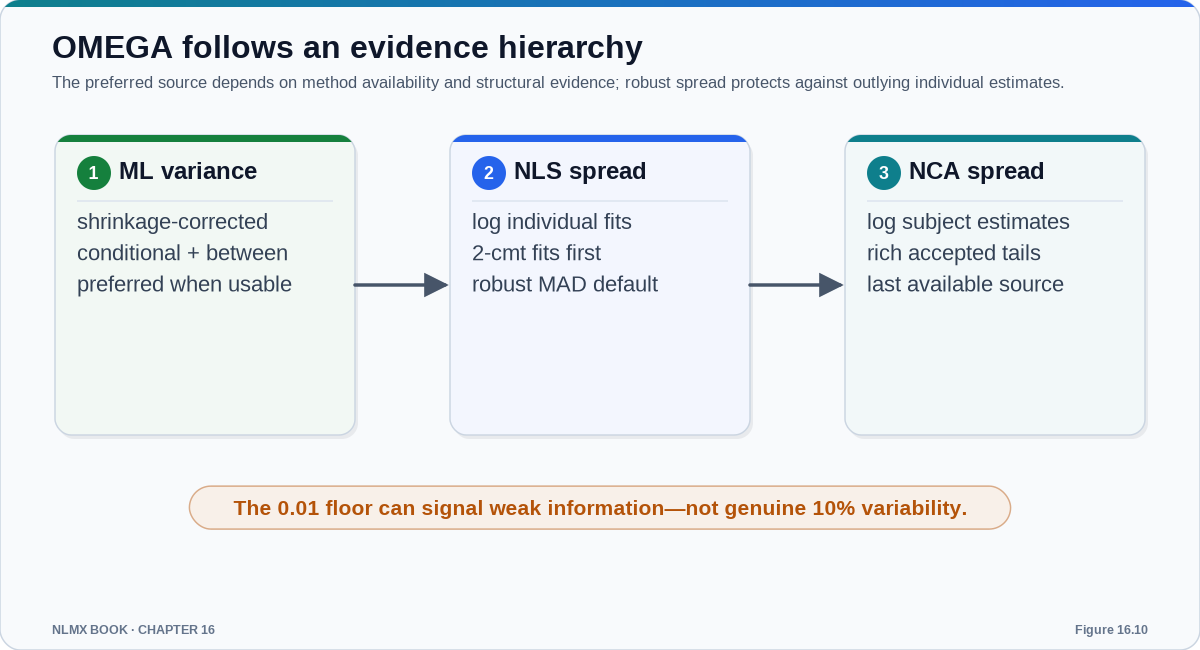
Source hierarchy
When available and structurally appropriate, ML population variance is preferred because it includes conditional variance and corrects shrinkage. Next comes the spread of individual NLS log estimates; for two-compartment evidence, two-compartment NLS fits take precedence for affected parameters. The spread of usable NCA estimates is the later fallback.
SOURCE names the chosen route. Do not infer it merely from which method column is populated; several methods can contribute typical values while one supplies OMEGA.
Robust versus classical spread
--omega-method robust is the default. It uses squared median absolute deviation after the 1.4826 consistency factor, limiting influence from outlying subject estimates. variance uses sample variance. Robustness protects a start but does not justify ignoring a genuine subpopulation.
OMEGA is constrained to a practical range. A reported variance of 0.01—the lower limit—often means the data have little information for that random effect, especially KA in sparse designs. It is not proof of exactly 10% CV. Consider omitting that ETA or testing it cautiously during model development.
Very large OMEGA can reflect wrong units, route, model structure, or failed individual fits. Inspect histograms and individual values before copying.
Common mistakes
- Treating autoinit OMEGA as a covariance-step estimate.
- Reading 0.01 as strong evidence of low variability.
- Using classical variance without investigating outliers.
- Assigning OMEGA to rule-of-thumb structural parameters automatically.
Checklist
- Read SOURCE for every OMEGA.
- Inspect individual log-value distributions.
- Compare robust and variance sensitivity when needed.
- Flag floor/ceiling values.
- Reestimate and diagnose ETAs in the population fit.
Further reading
See individual NLS, ML shrinkage correction, and individual outputs.