31.32 Reading FIM parameter, power, and matrix results
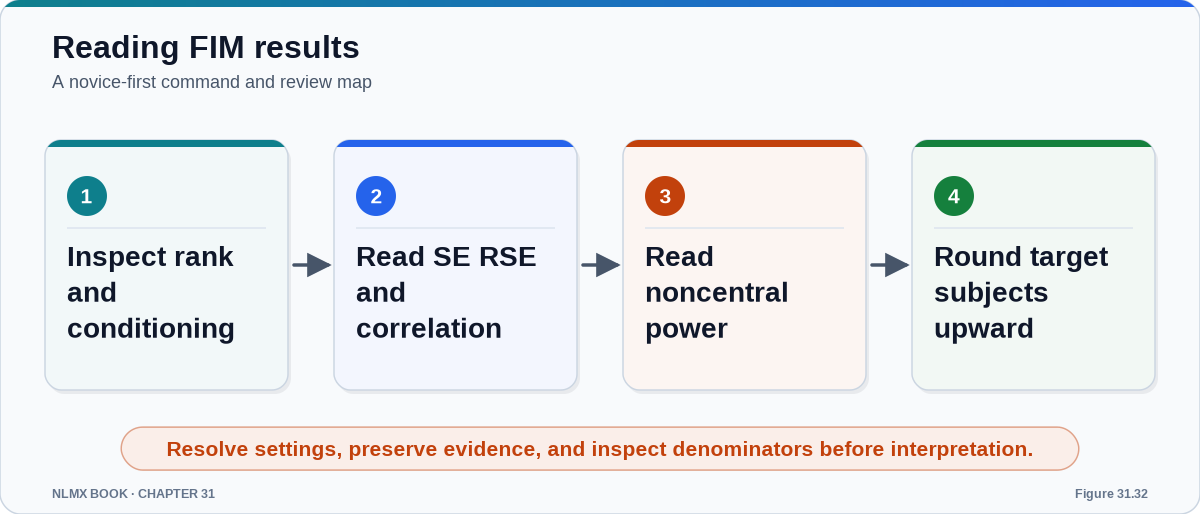
FIM output provides parameter value, expected SE/RSE and criteria; hypothesis SE, noncentrality, power and target N; and every information, covariance, and correlation cell. Nearly singular matrices carry explicit warnings.
What the controls mean
- RSE can be unstable near zero.
- Target N assumes information proportional to subjects and is rounded upward.
- Correlation exposes confounding that raw information diagonals hide.
The issued command is only the beginning of the audit trail. Always distinguish the reference model, the design template, the resolved scenario, the replicate-specific truth, the fitted result, and the test decision. A value can be correct at one layer and misinterpreted at another.
Command or settings pattern
Open fim_parameters.csv, fim_power.csv, fim_matrices.csv, and sample_size.csv.
Command-line values override settings-file values. Use a fresh folder for an analytical run; preserve the command, resolved settings, log, checksums, and row-level data. Defaults are versioned behavior, so a production protocol should state important values explicitly.
Interpretation and quality control
Recompute lambda from effect and SE, inspect maximum absolute correlations, and rerun the feasible rounded allocation.
For a novice review, first confirm counts and labels, then inspect numerical values, then ask whether the assumptions represent the proposed clinical study. For an expert review, additionally reconcile aggregates from row-level output, reproduce a subset of trials, and compare the implementation with an independent reference where the claim requires it.
Common mistakes
- Reading only the target-N column
- Ignoring ridge/rank warnings
- Reporting a point estimate without its denominator, interval, method, and version
Minimum evidence to retain
- nlmx version, command,
.powerfile, resolved settings, seed, threads, and output checksums; - control stream, design dataset, EXT/COV or parameter sets, and their provenance;
- scenario table, replicate rows and failures, method summaries, plots, report, and interpretation;
- prespecified criteria, Monte Carlo target, validation scope, deviations, and reviewer decisions.
Navigation
See the previous page, next page, and complete command and settings index.