20.28 Worked example: correlated CL and V with BLOCK OMEGA
The diagonal model assumes the CL and V ETAs are independent. The block example estimates their covariance by changing the random-effects record to a two-by-two BLOCK(2). The structural and residual models and dataset remain unchanged.
$OMEGA BLOCK(2)
0.04
0.01 0.04
nlmx fit documents/ch20/input/run20_block.ctl `
  --output documents/ch20/results/oral_block `
  --overwrite --approximation foce-i --no-cov-step `
  --carry-columns WT,GROUP --plots --plot-format both
The verified run converged in 20 iterations and 340 objective evaluations with a final maximum gradient of 6.502e-4. The OFV was −426.9860. The final variance estimates were 0.0564574 for CL and 0.0548899 for V, with covariance 0.0213229. nlmx reported the corresponding correlation as 0.383037. The conversion is
correlation = covariance / sqrt(variance_CL * variance_V)
Always distinguish those scales. Copying 0.0213 as a correlation would materially misdescribe the model. Confirm that the final OMEGA is positive definite and that the correlation is scientifically plausible. A correlation near ±1 often signals weak identifiability, redundant random effects, inadequate data information or a local solution.
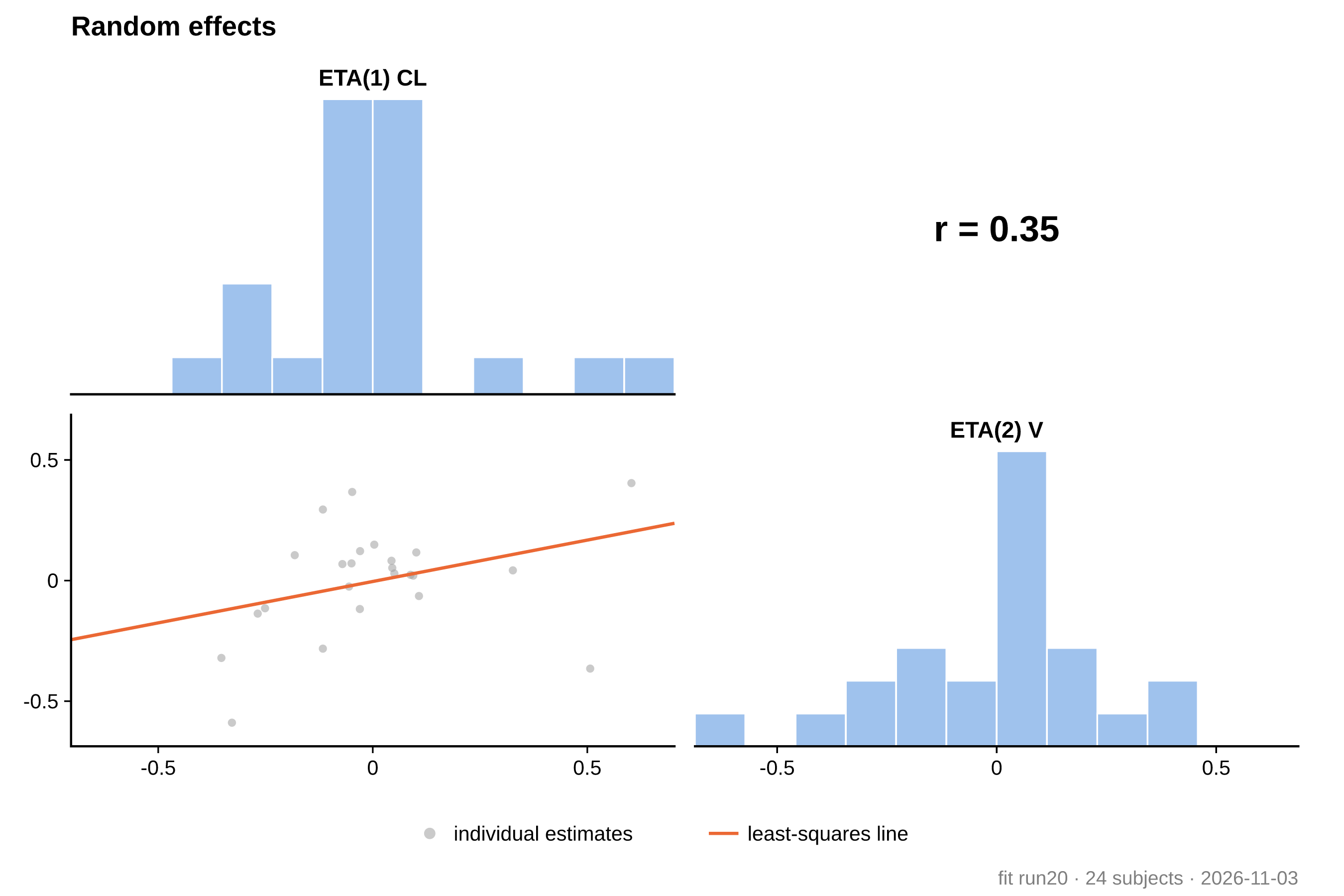
An ETA-pairs plot is supportive but does not replace the population covariance estimate. EBEs are shrunken conditional estimates; their empirical correlation can differ from the estimated OMEGA correlation, especially with sparse data or high shrinkage.
Because this example disabled covariance, it has no standard error for the added covariance parameter. The lower OFV relative to the diagonal FOCE-I run is useful only after confirming nestedness, identical records and likelihood settings. For inference, calculate the parameter-count difference deliberately, account for boundary/nonstandard conditions where relevant, and review biological plausibility and diagnostics—not only a likelihood-ratio threshold.
Common mistakes
- Confusing covariance with correlation.
- Inferring population correlation solely from EBE scatter.
- Adding every covariance without evidence or mechanistic rationale.
- Comparing runs with different predose or filtering rules.
- Keeping a near-singular block because it lowers OFV.
Checklist
- Verify BLOCK ordering against ETA definitions.
- Recalculate the reported correlation.
- Check positive definiteness and proximity to ±1.
- Compare nested runs under identical settings.
- Run covariance and sensitivity checks for the selected model.
Further reading
See OMEGA syntax, ETA outputs, and covariance problems.