34.7 Read boundaries, session-only writes, and resolved paths
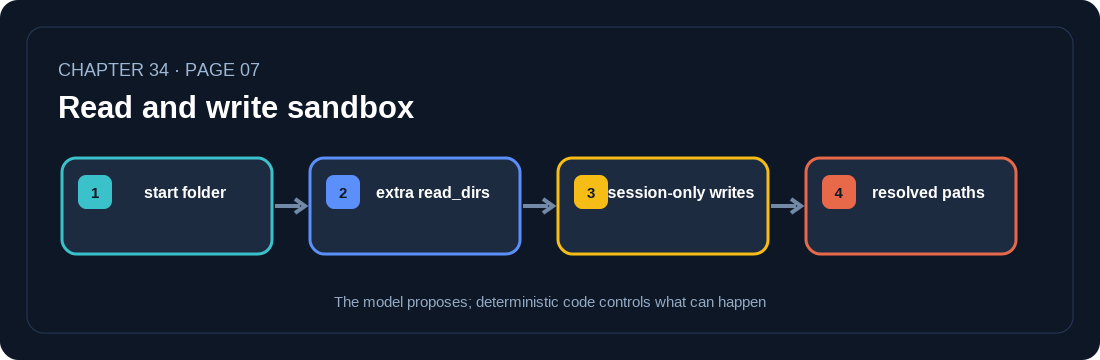
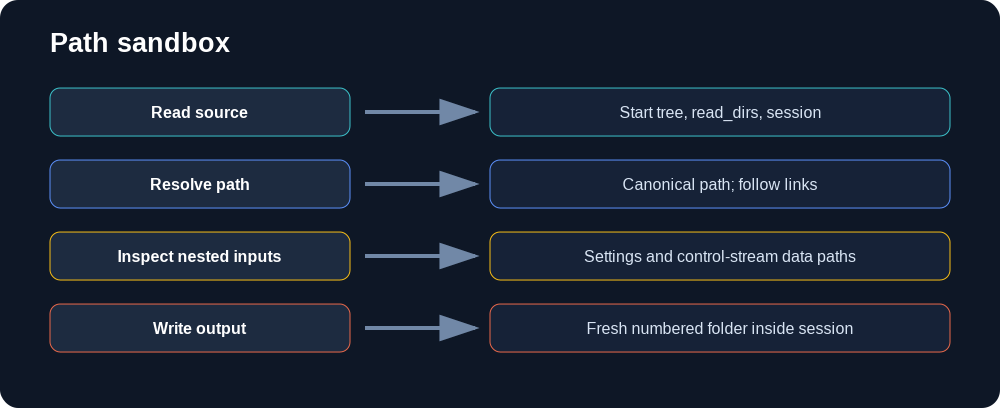
By default Maxson may read the start folder and descendants plus its session folder. [policy] read_dirs can add explicit folders. Paths are normalized and canonicalized when possible, symbolic links are followed, and .. tricks do not expand access. Since 4.14.2, checks inspect paths named inside settings files and $DATA in control streams.
How the mechanism works
Every command output is forced to a new numbered subfolder of the session. A model-provided output must be inside the session and empty. --fix-output is likewise constrained. The assistant does not overwrite the source dataset, control stream, or external run directory.
Evidence from nlmx 4.16.1
The approved mock command was rewritten with --output .../allowed-run/01_qc-data. Its settings file was copied into that step folder. The original data/er/er_data.csv remained a read-only input.
What the mechanism protects—and what it does not
The mechanism controls a defined part of the workflow. It does not make the model’s prose correct, select the right scientific question, validate external data, or transfer accountability away from the user. Treat policy safety, computational success, statistical adequacy, and scientific validity as separate conclusions.
Review practice
Read permission does not imply suitability to disclose contents to a remote backend. Path containment also does not classify data. Sites must define allowed roots, access controls, retention, backup, and whether even local model context may contain sensitive identifiers.
For a novice, read the human transcript first, then the JSONL event log, exact settings/commands, and native command outputs. “The session completed” describes the outer process only; individual proposals may have been planned, declined, refused, failed, corrected, or executed.
Evidence to retain
- nlmx version/build, backend identity,
.asksettings, policy, limits, and system prompt; - request, raw replies, help/manual/file context events, confirmations, refusals, and corrections;
- every settings version and exact executed command, with child exit status and full output;
- reviewer interpretation, unresolved warnings, scientific limitations, and final disposition.
Navigation
See the previous page, next page, and guardrail, policy, and audit index.