34.5 Allowed commands, self-invocation, and the no-shell boundary
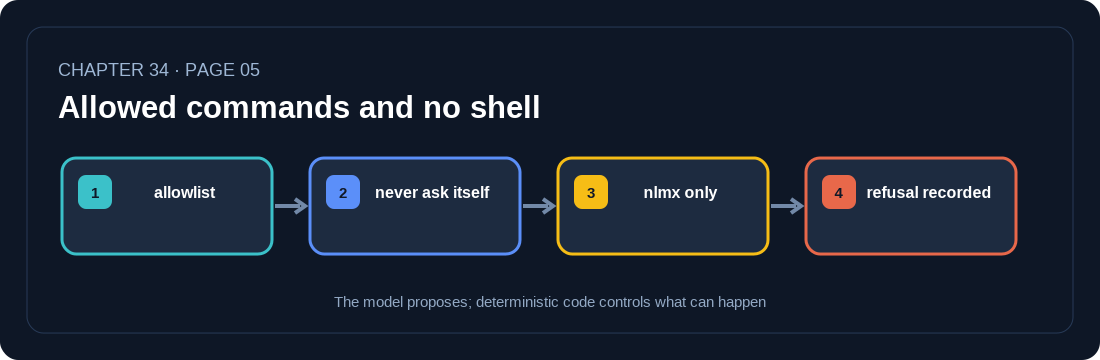
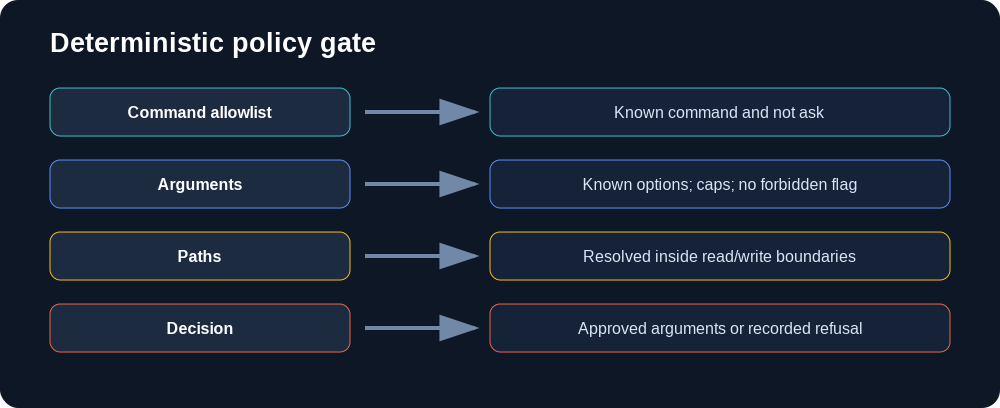
Policy starts with an explicit nlmx command allowlist. A command omitted from it is refused. ask is always refused even if someone tries to add it, preventing recursive assistants. The architecture accepts nlmx subcommands only; there is no field for a shell program, pipe, redirection, or arbitrary executable.
How the mechanism works
The compiled 4.16.1 no-config default includes inspect, validate, qc-data, qc-nm, eda, custom, report, nca, autoinit, screen, fit, vpc, forest, cov, posterior, sims, power, er, generate, and schema. Resume, simulate-study, version, and ask are absent by default; ask cannot be enabled.
Evidence from nlmx 4.16.1
The executed refusal proposed nlmx ask "start another assistant". nlmx recorded “the assistant may not start itself,” ran zero commands, returned the reason to the mock model, and ended normally with one refusal.
Executed evidence: Executed refusal transcript.
What the mechanism protects—and what it does not
The mechanism controls a defined part of the workflow. It does not make the model’s prose correct, select the right scientific question, validate external data, or transfer accountability away from the user. Treat policy safety, computational success, statistical adequacy, and scientific validity as separate conclusions.
Review practice
An allowlist limits capability, not scientific scope. Sites should remove commands they do not need. A refused action is not a process error—the session can exit 0—so compliance automation must inspect audit events and request summaries, not only the process exit code.
For a novice, read the human transcript first, then the JSONL event log, exact settings/commands, and native command outputs. “The session completed” describes the outer process only; individual proposals may have been planned, declined, refused, failed, corrected, or executed.
Evidence to retain
- nlmx version/build, backend identity,
.asksettings, policy, limits, and system prompt; - request, raw replies, help/manual/file context events, confirmations, refusals, and corrections;
- every settings version and exact executed command, with child exit status and full output;
- reviewer interpretation, unresolved warnings, scientific limitations, and final disposition.
Navigation
See the previous page, next page, and guardrail, policy, and audit index.