34.6 Option parsing, forbidden flags, and numeric caps
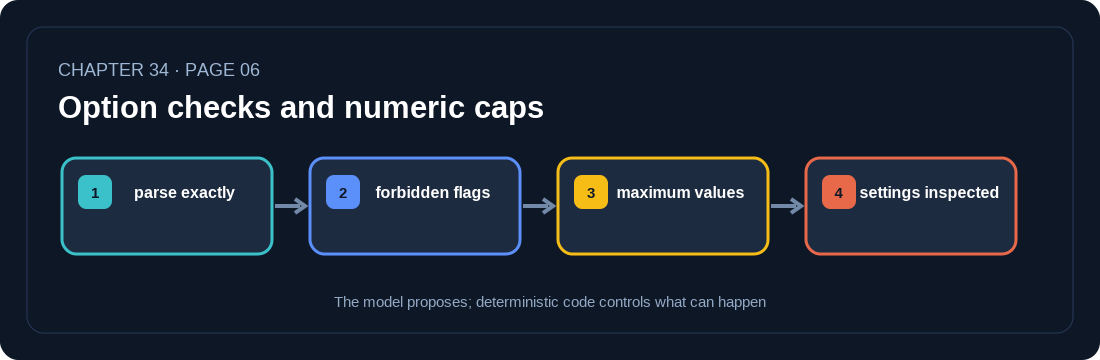
Approved command lines must parse exactly through nlmx’s own CLI definitions. Unknown flags, missing values, or incompatible syntax are refused. Built-in forbidden options protect session integrity and privacy: --overwrite, --log-file, --print-config, --run-dir, and --keep-subject-ids; site policy can add more.
How the mechanism works
Numeric limits default to --subproblems≤1000, --samples≤5000, --study-replicates≤200, and --replicates≤1000. Limits apply both to command-line options and matching settings-file values. A site may add a cap such as --threads=4 or tighten existing maxima.
Evidence from nlmx 4.16.1
The policy catalog understands short/long option names and which options take values. Settings files and nested inputs are inspected, so moving a forbidden or excessive value from the command line into TOML does not evade the check.
What the mechanism protects—and what it does not
The mechanism controls a defined part of the workflow. It does not make the model’s prose correct, select the right scientific question, validate external data, or transfer accountability away from the user. Treat policy safety, computational success, statistical adequacy, and scientific validity as separate conclusions.
Review practice
Caps are operational guardrails, not guarantees of adequate statistics. A maximum of 1000 replicates may be too small for a scientific objective; a permitted value may still be wasteful. Review both lower adequacy requirements and upper resource limits.
For a novice, read the human transcript first, then the JSONL event log, exact settings/commands, and native command outputs. “The session completed” describes the outer process only; individual proposals may have been planned, declined, refused, failed, corrected, or executed.
Evidence to retain
- nlmx version/build, backend identity,
.asksettings, policy, limits, and system prompt; - request, raw replies, help/manual/file context events, confirmations, refusals, and corrections;
- every settings version and exact executed command, with child exit status and full output;
- reviewer interpretation, unresolved warnings, scientific limitations, and final disposition.
Navigation
See the previous page, next page, and guardrail, policy, and audit index.