Worked example: accelerated versus full search
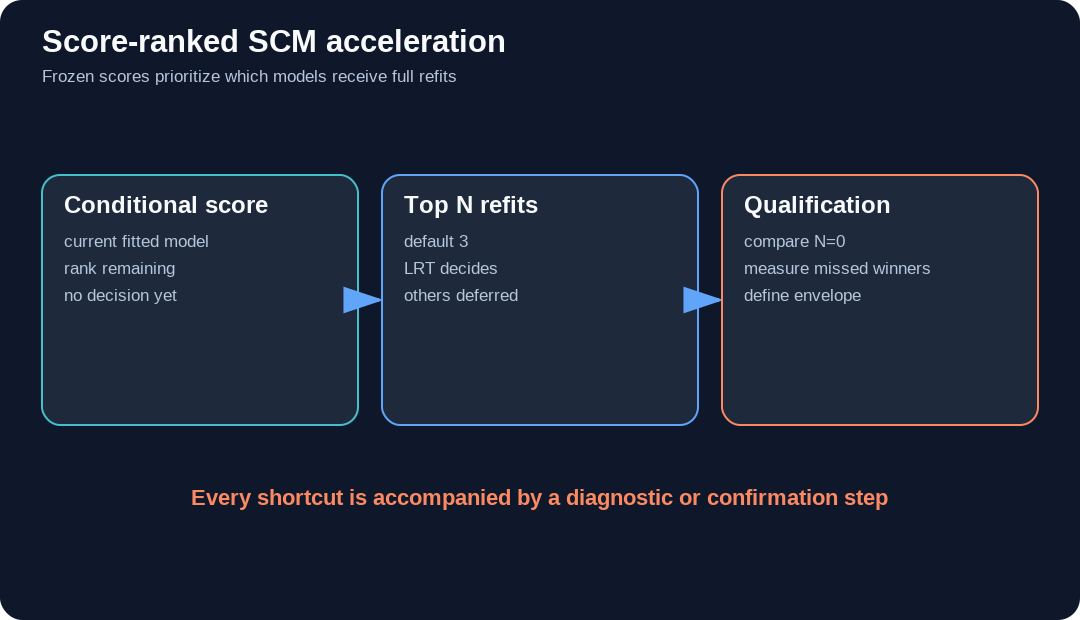
The accelerated run refitted the best three score-ranked candidates per forward step. The reference run used --scm-candidates-per-step 0 and refitted every remaining candidate. Both added the same effects in the same order, stopped at the same active set, passed the same backward audit, and reached OFV −1157.8135 with matching coefficients.
Their traces differed in coverage: 23 rows for the accelerated run versus 26 for full search, because low-ranked candidates were omitted from some accelerated steps. The equality of endpoints validates the cap only for this example. It does not prove the omitted refits could never matter in a wider, correlated, or weak-effect scope.
An acceleration qualification should repeat this paired design over a frozen suite and summarize endpoint agreement, rank of the full-search winner, OFV and coefficient tolerances, failure patterns, and runtime. Use full search when disagreement has unacceptable scientific cost.
Common mistakes
- Treating a stepwise p-value as clinical importance or causal proof.
- Reading a candidate comparison without its active model, convergence state, degrees of freedom, and exact threshold.
- Reporting only the terminal relationship list while discarding failed models, path decisions, configuration, and provenance.
Page checklist
- The scientific question, model identities, and comparison direction are explicit.
- Numerical validity is reviewed before interpreting statistical evidence.
- The result is linked to the complete trace and final joint-model diagnostics.