42.4 Risk scoring and test depth
What you will learn
- Score a failure mode by severity, probability and detectability, and compute the risk priority number.
- Map the class (High, Medium, Low) to a test depth you can defend.
- Read the 42-line register, including the five highest scores.
- Adapt the scores to your intended use, and list what is deliberately not tested.
Prerequisites: 42.3 Requirements.
Testing everything equally deeply is impossible; testing everything lightly is irresponsible. The risk assessment is the device that spends effort where a silent error would do most harm. The package uses an ICH Q9-style failure-mode scoring.
The three scales
| Scale | 1 | 2 | 3 |
|---|---|---|---|
| Severity: effect on a decision or on record integrity | cosmetic or easily recovered | a secondary output is wrong and is noticed in review | a primary result or record is wrong; could affect a decision or a submission |
| Probability: likelihood of a defect, from complexity, novelty and history | simple, long-used code | moderate complexity | complex numerical algorithm or recently changed |
| Detectability: would a user notice without a special check? | obvious (error, crash, empty file) | noticeable when outputs are reviewed | silent: plausible-looking but wrong numbers |
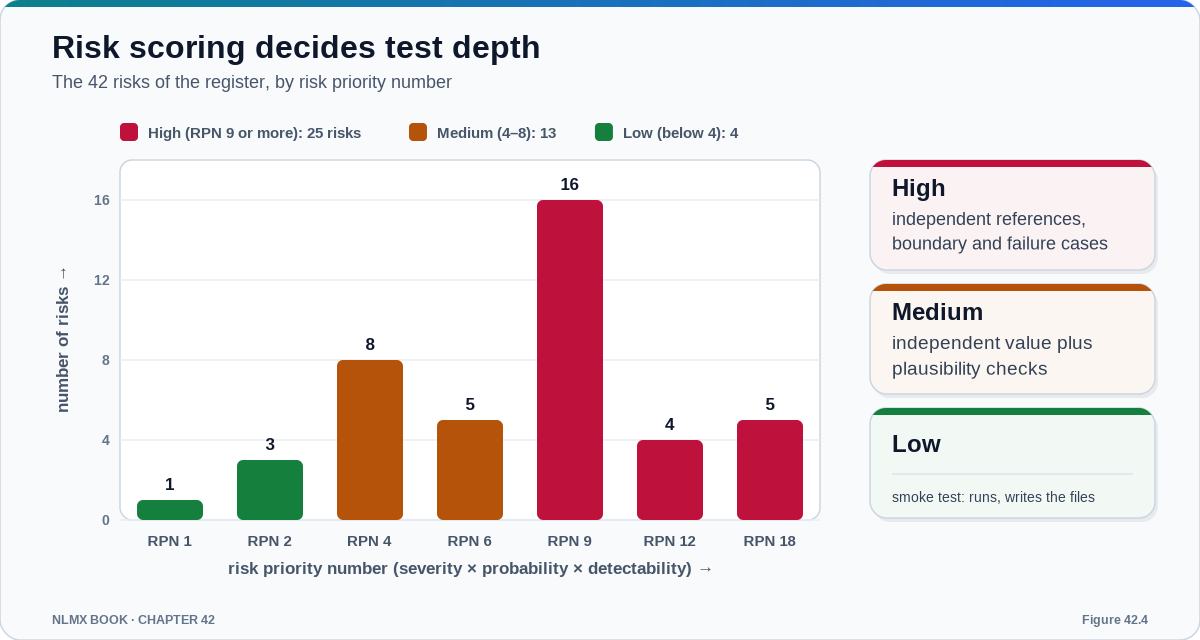
The risk priority number is RPN = S × P × D, between 1 and 27. The class follows: High ≥ 9, Medium 4–8, Low < 4.
Note the asymmetry in the definition of D. A crash has a low detectability score, because it is obvious; a plausible but wrong objective function has the highest. The scale rewards loud failures and punishes quiet ones, which is exactly what a pharmacometric tool needs: a misestimated clearance does not announce itself.
Worked scoring
| ID | Function | Hazard | S | P | D | RPN | Class |
|---|---|---|---|---|---|---|---|
| RK-01 | Objective function (FOCE-I, Laplace, FO, FOCE, SAEM) | wrong objective or estimates, silent | 3 | 2 | 3 | 18 | High |
| RK-02 | Predictions, residuals, ETAs | wrong IPRED/PRED/residuals feeding diagnostics | 3 | 1 | 3 | 9 | High |
| RK-05 | Output files (.ext, .phi, .cov …) |
malformed files break downstream tools | 2 | 1 | 2 | 4 | Medium |
| RK-18 | Markdown to DOCX/PDF/HTML | report loses text or tables | 2 | 1 | 1 | 2 | Low |
| RK-42 | Per-command help and option ranges | help that misleads | 1 | 1 | 1 | 1 | Low |
RK-01 reads: severity 3 because the objective drives every comparison; probability 2 because the algorithms are mature but numerically intricate; detectability 3 because a wrong OFV looks like any other number. 3 × 2 × 3 = 18. RK-18 reads: a report that loses a table is annoying (2), unlikely (1), and obvious on opening (1): 2.
The register in numbers
The register holds 42 risks: 25 High, 13 Medium, 4 Low. The distribution in the figure above has one big step: sixteen risks score exactly 9 (a 3 on two scales and a 1 on the third). The five risks scoring 18, the register's maximum, are:
| ID | Area | Hazard |
|---|---|---|
| RK-01 | fit | wrong objective function or estimates |
| RK-03 | fit | ODE or matrix-exponential result differs from the closed form |
| RK-22 | data integrity | existing results silently replaced |
| RK-24 | data integrity | result not reproducible, or dependent on threads or line endings |
| RK-32 | fit | model-language items: tied SAME blocks, reserved data names, fractional event items truncated silently |
All five score the maximum detectability: a failure would be silent. Two are about the records, not the mathematics—an overwritten result and an irreproducible one are as damaging to a submission as a wrong number, and the register treats them accordingly.
From class to test depth
| Class | Depth in the package | Example |
|---|---|---|
| High | Expected values from an independent source; boundary and failure cases; repeated at every revalidation | RK-35: three AUC profiles against 80-digit reference values (OQ-NCA-007) |
| Medium | Comparison with independent or known values where possible, plus structure and plausibility checks | RK-05: output files present, with headers, iteration markers and row counts |
| Low | Functional smoke test: the command runs, writes the documented files, the values are in the right region | RK-18: text and tables survive in DOCX/PDF (OOXML search, PDF header) |
Of the 118 tests, 51 carry a High class, 41 Medium and 26 Low. The effort follows the register, not the number of commands.
Adapt the scores to your use
The register is the supplier-independent starting point; the validation lead reviews and signs it. Two common adjustments:
- Raise severity where the output drives a dose. If your group selects doses from
simsor sample sizes frompower, set S = 3 for RK-10 and RK-11. RK-11 (FIM and SSE) is presently S = 3, P = 1, D = 2 = 6 (Medium); with D = 3 it becomes 9 and moves to High, and OQ-PWR tests deserve the same independent recomputation the High class implies. - Lower severity where review is guaranteed. If every plot is reviewed by a second person before use and plots are never used to compute anything, RK-15 could stay Medium or fall to Low. Write the reason in the register; an unexplained downgrade is the first thing an inspector will ask about.
When you change a score, you change what must be tested, so the change goes through the same change control as a test edit (page 42.17).
What is deliberately not tested
The package states its residual risk. Each line has a compensating control:
| Not tested automatically | Why | Compensating control |
|---|---|---|
| Left-censoring (BLQ) rules across vpc, sims, power, screen, autoinit | many data-dependent combinations | document the strategy in the analysis plan; verify with the analysis data set; add a site protocol |
| Accuracy beyond the tested structures (3-compartment, transit, non-linear elimination, time-varying covariates) | accuracy depends on the data | model qualification in each analysis; comparison with an independent tool when critical |
| Standard errors of non-linear models | exact standard errors are tested for the linear model only; non-linear models use numerical derivatives | compare key standard errors with a bootstrap or SIR for a submission model |
| Graphics appearance and DOCX/PDF layout | judged visually | review before release; IQ-006 checks that the files are produced |
| Real language-model behaviour | non-deterministic and model-dependent | guardrails tested (OQ-ASK-001, 002, 005); a manual test; human review of each proposed command |
A residual-risk table is not a confession of weakness; it is the part of the assessment that lets a reader decide whether the package covers their use. If your use sits in that table, extend the package (page 42.3 shows how) before relying on it.
Review checklist
- Has each severity been reviewed against the intended use and signed?
- Is every High risk traced to at least one test with an independent reference?
- Is every downgrade justified in writing?
- Does your use touch any line of the residual-risk table?
Navigation
See the previous page, the next page and the complete validation reference.