28.18 Sampling times and reference dose
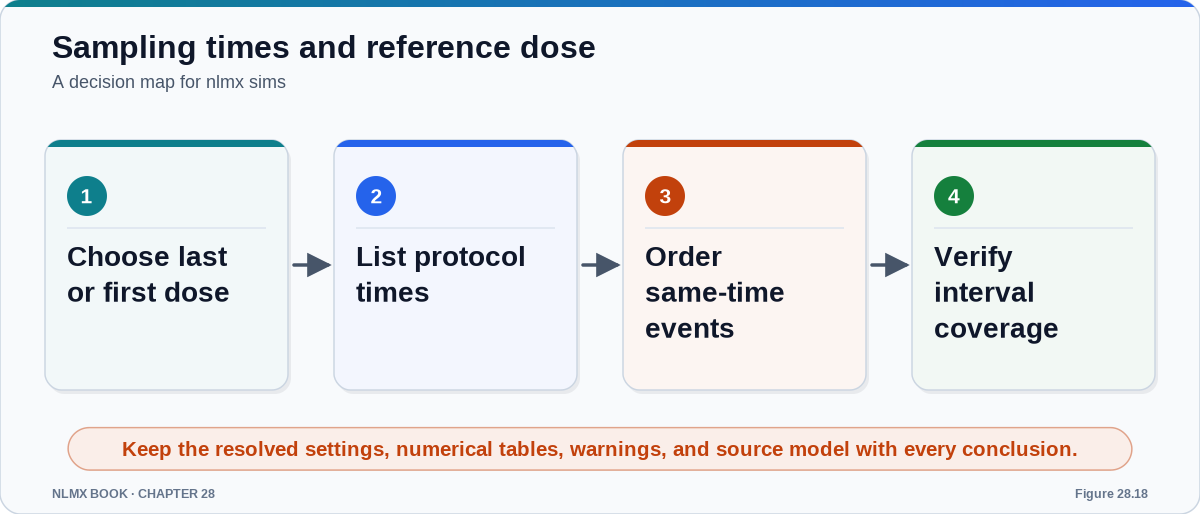
Sampling times default to a 12-point interval design scaled to tau. --sample-times provides protocol-specific hours, and --sample-relative-to last-dose|first-dose defines their reference. A sample at a dose time follows the dose record; for an oral model its immediate concentration may still represent the predose trough, whereas an IV bolus can show an immediate peak.
Why this matters
This decision changes what population, random quantity, time interval, or numerical summary the command represents. For a novice, the safest habit is to write the question in one sentence before choosing an option, then verify that the resolved settings and output columns express that same question. For a reviewer, the important distinction is between what was assumed, what was randomly generated, what was calculated, and what can legitimately be concluded.
Detailed behavior
- Use last-dose reference for a steady-state interval and first-dose reference for a complete finite course when appropriate.
- Dense metrics add their own grid and requested time points; protocol sampling still controls
_sim.csvand sampled/observed metrics. - Include early absorption and late elimination times needed for the question.
- Check that the profile covers all partial-AUC and point-concentration requests.
The subject-level table is the bridge between the design and the exposure result. Use it to check IDs, arms, population labels, age, sex, weight, dose, interval start, tau, ETA values, and added covariates. Use the metric table to check one row per subject and simulation, the requested metric columns, and COVERED. Use pooled and replicate summaries for different purposes: pooled rows describe all simulated subject outcomes, while replicate intervals describe how a finite simulated study result varies from study to study.
Example command or settings fragment
nlmx sims run.ctl --sample-times 0,0.5,1,2,4,8,12,24 --sample-relative-to last-dose
Start with a small smoke run and inspect the transcript before scaling. For command-line work, quote expressions containing comparison signs, brackets, or commas as required by the shell. For a permanent analysis, prefer a settings file: it exposes settings-only controls, resolves paths relative to itself, rejects unknown keys, and is echoed in fully resolved form with the output.
Interpretation and quality control
Plot the design before simulation and distinguish nominal from actual time. If sampled metrics miss the true peak, that is a design limitation rather than a dense-profile model failure.
At minimum, reconcile the console summary with the CSV/JSON result, inspect warnings and notes, confirm subject and observation counts, verify requested groups and targets, and review the source model's applicability. A chart can reveal shape and subgroup patterns, but every reported number should come from the tables. If a result changes a decision, run a prespecified sensitivity for Monte Carlo stability, parameter uncertainty, population assumptions, and the metric-profile source.
Common mistakes
- Assuming dense metrics use only sample times
- Misreading time zero ordering
- Requesting AUC beyond the covered sampled interval
Also avoid overwriting a completed evidence folder merely to change styling. Create a new scenario directory or preserve the prior checksums so analytical changes remain distinguishable from presentation changes.
What to retain and report
- the nlmx version, complete issued command, submitted settings, and resolved
_settings.sims; - CTL, selected EXT, optional COV or parameter table, and supplied dataset or population-generation assumptions;
- seed, subproblems, thread count, ETA/EPS and parameter-uncertainty policy;
- metric interval, tau, profile source, grid, integration rule, group definitions, and target limits;
- numerical tables, JSON, HTML, figures, transcript, checksums, warnings, sensitivities, and scoped interpretation.
Navigation
See the previous page, next page, and complete sims command and settings index.