30.14 Parameter uncertainty and assurance
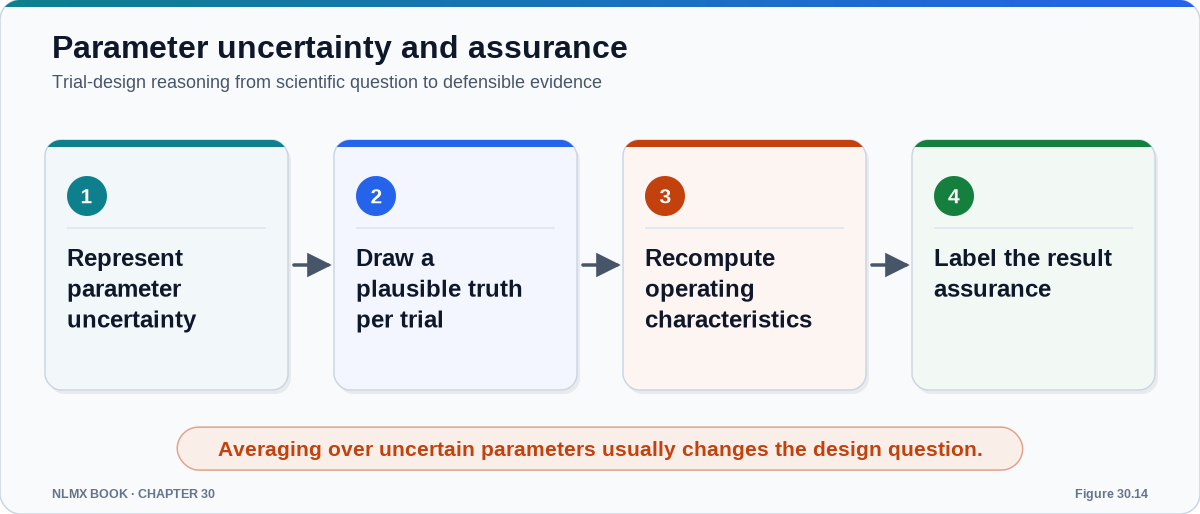
Reference-model parameters are estimates, not constants known without error. Parameter uncertainty analysis draws a plausible parameter vector for each trial, then simulates and estimates under that truth. nlmx can use a multivariate normal based on the reference covariance or an empirical table. The resulting rejection fraction is assurance: expected conditional power over the declared uncertainty distribution.
Concepts to keep separate
- The covariance matrix must use the same parameter ordering, transformation, and scale as the simulation truth.
- Correlated draws preserve joint uncertainty; independent marginal draws generally do not.
- Inadmissible draws need transparent rejection and redrawing rules. Frequent rejection indicates the chosen approximation is inappropriate.
- Uncertainty in fixed effects, random effects, residual error, and covariate effects can influence assurance differently.
Terminology matters because a single scenario can contain several denominators and several sources of randomness. Truth is the parameter vector used to generate a replicate. Estimate is the value recovered from that replicate. Design is the planned arrangement of subjects, arms, doses, and observations. Method is the approximation or simulation–estimation procedure used to predict performance. A credible report labels all four.
Mathematical or operational walkthrough
If smaller effects coincide with larger variability, preserving that negative information correlation may reduce assurance much more than varying either parameter alone. The joint draw, not a list of marginal confidence intervals, defines the calculation.
For novices, read every expression from the inside out: identify the scientific effect, identify the null value, put both on the same parameter scale, identify the variance or information that belongs to the actual design, and only then calculate a test statistic or sample size. Units and parameterisation should cancel in a way that leaves a dimensionless statistic.
How this maps to nlmx
Report conditional power at representative parameter sets alongside assurance. This makes a low assurance interpretable: readers can determine whether it reflects plausible small effects, poor precision, or unstable tails.
Chapter 30 explains the statistical and implementation concepts. Chapter 31 gives the complete nlmx power command, every CLI and settings control, precedence, output schema, and production workflow. This separation is deliberate: choosing an option correctly requires understanding which estimand and assumption it changes.
Quality-control checklist
- Is the covariance file compatible with the model labels?
- Are bounds and redraw counts recorded?
- Is the result called assurance?
- Are influential parameter draws diagnosed?
The graph is explanatory; the CSV, JSON, resolved settings, model inputs, and replicate rows are the authoritative evidence. When a plotted point looks surprising, diagnose the underlying rows before changing the design.
Common mistakes
- Drawing only the tested effect and fixing all nuisance parameters
- Ignoring parameter correlations
- Presenting an unconditional average as power at the point estimate
Also avoid copying a sample size from a nearby project. Power is conditional on the model, tested effect, covariate distribution, schedule, residual and random variability, attrition, test, estimator, and success criteria. Similar-looking studies can have very different information.
Evidence to retain
- scientific question, estimand, hypothesis, alpha, target, and criteria;
- model/data/design inputs, parameter source and uncertainty distribution;
- software version, method, approximation, seed, threads, command, and resolved settings;
- scenario grid, row-level results, failures, denominators, intervals, diagnostics, and checksums;
- scripts that calculate derived tables and figures, plus the interpretation and limitations.
Navigation
See the previous page, next page, and formula and decision index.