33.2 Dataset format, identifiers, and row grain
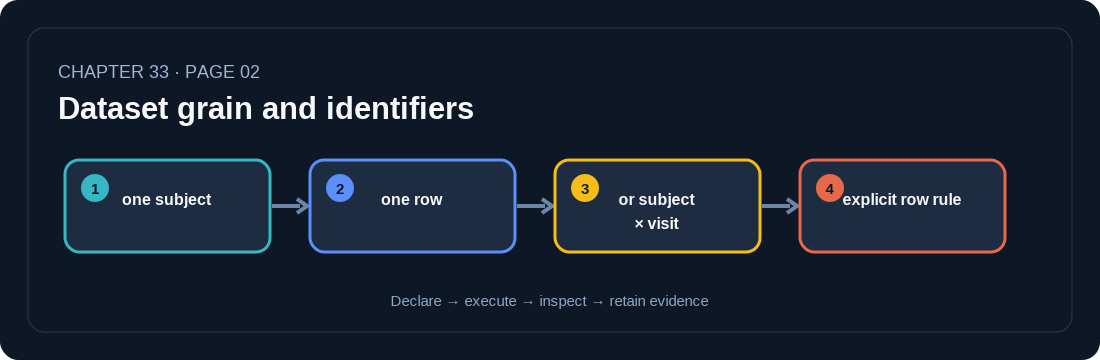
The reader detects comma, semicolon, tab, or whitespace delimiters from the header. Quoted text is supported. Missing tokens default to ., NA, NaN, and empty cells. Subject-level types normally require one row per subject; longitudinal requires subject × visit rows.
Command or configuration pattern
nlmx er er.csv --id-col USUBJID --subject-rows error ...
The relevant controls are: [data] file/id/missing/subject_rows; --data; --id-col; --subject-rows. Use the complete command and settings index for accepted values, defaults, CLI mappings, and settings-only controls.
A reliable operating sequence
- State the endpoint estimand, exposure metric/window/units, analysis population, adjustment set, and clinically useful contrast.
- Reconcile input rows, subjects, arms, exposure availability, endpoint information, and all endpoint-specific fields.
- Run the smallest useful specification first; inspect exclusions and eligible models before adding subgroups, selection, or bootstrap.
- Read absolute predictions and observed support alongside relative effects, information criteria, p-values, and diagnostics.
- Archive the command,
.erfile, mutated/used data, exclusions, transcript, tables, plots, report, version, and checksums.
How to read and review the result
Audit duplicate identifiers before modelling. first and last depend on file order; mean can be scientifically invalid for categorical or time-dependent columns; all changes the analysis unit. Prefer an explicit filtered row when repeated records have clinical meaning.
For a novice, the safest reading order is er_summary.txt → er_analyses.csv → the analysis-specific exclusions and model table → effects/predictions → diagnostic plots → row-level data → report.html. The report is a presentation layer; the CSV/JSON files and transcript are the audit layer.
Quality-control questions
- Did the number of analysed subjects, events, categories, exposure groups, and visits match the specification?
- Were placebo, active zeros, missing values, filters, repeated rows, categories, offsets, censoring, and covariate references handled as intended?
- Were ineligible fits retained and explained rather than silently dropped or allowed to win?
- Does the reported contrast stay inside exposure support, and are its units and endpoint direction clear?
- Do diagnostics and sensitivities support the same decision, and are causal and transportability limits explicit?
Common failure modes
- Treating the best criterion or smallest p-value as a clinical conclusion.
- Reading an odds, rate, or hazard ratio without its exposure contrast and absolute outcome context.
- Overwriting an evidence directory before preserving the prior settings, log, and checksums.
Navigation
See the previous page, next page, and complete command and settings index.