Differences from PsN SCM
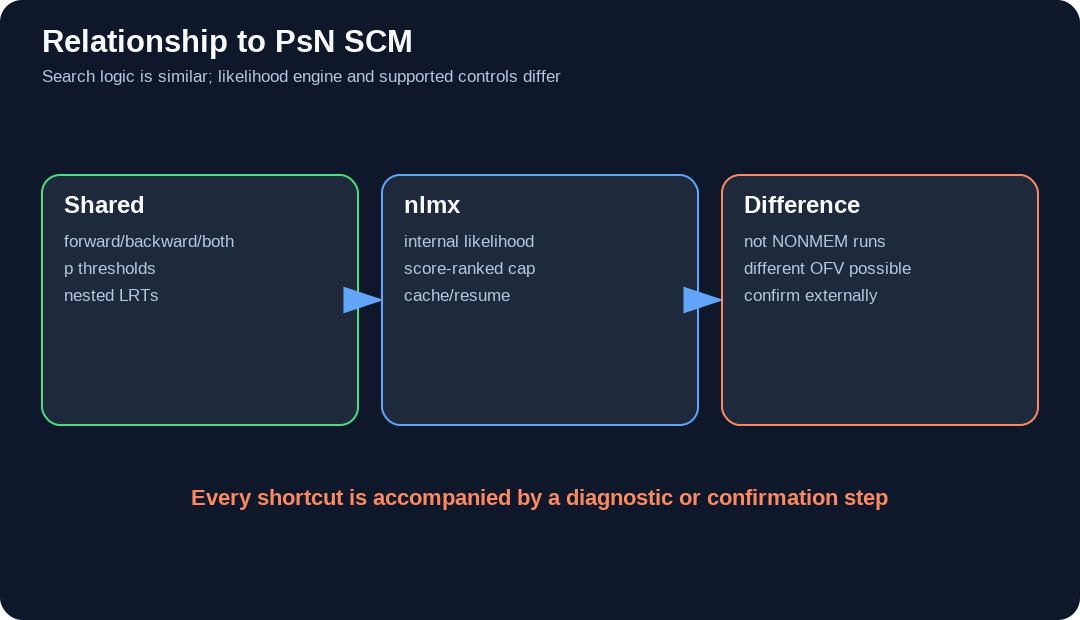
nlmx and PsN SCM share recognizable concepts: scoped relationships, forward inclusion, backward elimination, p-value thresholds, nested refits, and path reporting. With --scm-candidates-per-step 0, nlmx refits all remaining forward candidates, which is the closest candidate-coverage analogue.
They are not interchangeable engines. PsN ordinarily creates and runs NONMEM models; nlmx 4.8.0 evaluates its internal likelihood and optimizer. Equation generation, starting values, approximation details, failure recovery, categorical handling, caches, configuration grammar, and output schemas differ. Some PsN controls have no direct one-to-one nlmx counterpart.
For migration, freeze data and model coding, map each relationship/form/reference explicitly, use exhaustive search, compare every candidate model's convergence and OFV, and define tolerances before looking at the results. Label unexplained differences rather than implying equivalence from a matching final list.
Common mistakes
- Treating a stepwise p-value as clinical importance or causal proof.
- Reading a candidate comparison without its active model, convergence state, degrees of freedom, and exact threshold.
- Reporting only the terminal relationship list while discarding failed models, path decisions, configuration, and provenance.
Page checklist
- The scientific question, model identities, and comparison direction are explicit.
- Numerical validity is reviewed before interpreting statistical evidence.
- The result is linked to the complete trace and final joint-model diagnostics.