23.16 Nuisance information: observed versus from-cov
--nuisance-information observed constructs the nuisance block from nlmx's own reconstructed likelihood. It is the default and keeps candidate, cross, and nuisance information on one likelihood and parameter scale. The word “observed” here names the nuisance source and should not be confused with --information-estimator observed; OPG candidate/cross information can still use a nuisance block evaluated by nlmx.
--nuisance-information from-cov uses the inverse of the imported covariance matrix. It can be attractive when the reference covariance step is trusted, but it may mix NONMEM covariance-step information with candidate/cross blocks from a different approximation. If estimation method, parameter transform, covariance method, rounding, or mapping differs, the Schur complement can become incoherent or negative. When no invertible .cov exists, nlmx warns and falls back to observed nuisance information.
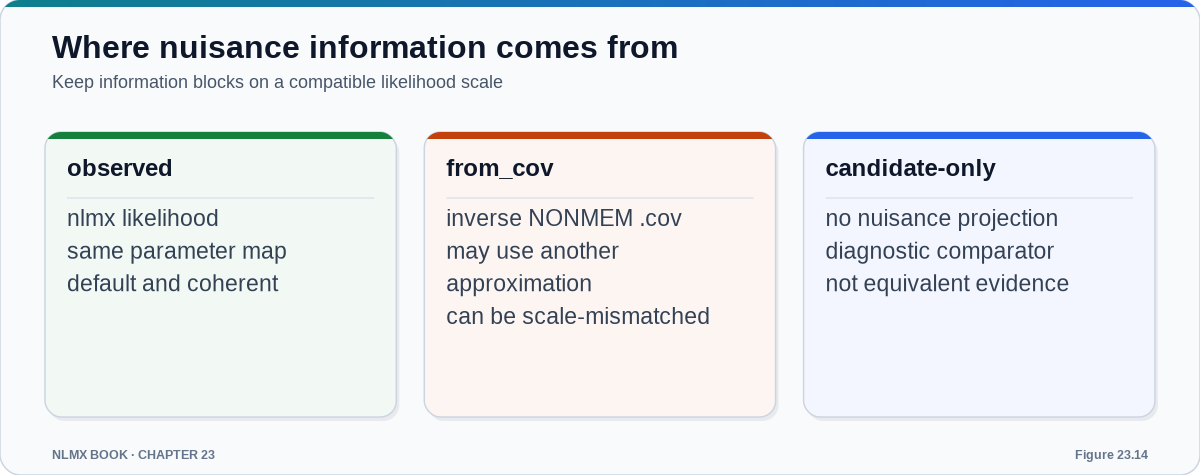
Use from-cov as a qualified sensitivity analysis unless equivalence of scales has been demonstrated. Reconcile .cov and .cor, inspect condition number and labels, and compare efficient eigenvalues and classifications with the default. A lower p-value is not evidence that the alternative source is better.
Compatibility questions for from-cov
Before using inverse .cov, answer five questions: Was the covariance step computed for the same final estimates? Are parameter labels and transforms identical? Did the reference software use the same likelihood approximation? Does the matrix include or exclude boundary/fixed parameters consistently? Is its numerical condition adequate for inversion? A “yes” to file presence is not enough. Compare diagonal scales and a few correlations against the nlmx nuisance block. If the efficient matrix changes sign or rank, do not choose the source by which produces smaller p-values; treat the disagreement as a model-qualification problem and use targeted refits for decisions.
Common mistakes
- Confusing two different uses of the word observed.
- Treating inverse
.covas universally compatible information. - Using a covariance matrix from another run or parameter ordering.
- Selecting the source that retains more effects.
- Ignoring fallback behavior when
.covis unusable.
Checklist
- Verify
.covidentity, labels, method, and conditioning. - Use nlmx-observed nuisance information as the primary default.
- Label
from-covas a sensitivity unless qualified. - Compare eigenvalues, adjustment, and outcomes.
- Preserve normalized configuration and warnings.
Further reading
See efficient information and Chapter 20's covariance-output pages.