23.25 Backward retention and uncertain relationships
After forward inclusion stops, the engine tests whether each selected relationship remains convincing in the presence of the others. For a term under review, the other active terms form the reduced conditioning set and the candidate is rescored. A term whose p-value is at or above --retention-alpha is removed. The default retention alpha is 0.01, stricter than the default forward threshold.
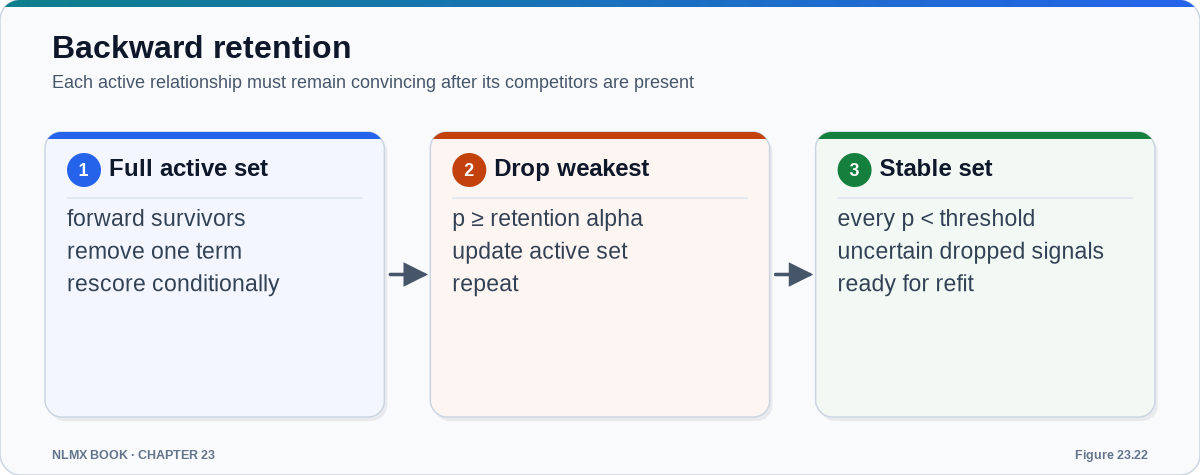
The verified example removed CL–EGFR at p 0.0182 and CL–WT at p 0.0142, retaining only V–WT. Because both CL relationships had strong adjusted univariate evidence, nlmx classified them as uncertain, not simply rejected. SCM subsequently retained both after full likelihood refits. This illustrates why uncertain is an escalation class: local conditional score evidence and refit path evidence disagree about strength under the strict retention rule.
Backward order is path-dependent. Removing one competitor can change the next test. Preserve the trace and exact thresholds. A relationship that never entered is not subjected to the same retention question as one removed later.
Why a stricter backward threshold can remove true effects
A true effect may enter because it improves the model alone yet fail a stricter conditional retention test when another correlated effect is present. Finite sample variability, local one-step coefficients, nuisance adjustment, and threshold asymmetry all contribute. This is not contradictory: forward and backward tests use different active sets and decision cutoffs. Review refit ΔOFV for removal from the joint set when the distinction matters. In the teaching example, each CL effect remained strongly supported by SCM despite frozen backward p-values just above 0.01. A robust workflow records that disagreement instead of forcing the labels to match.
Common mistakes
- Treating every nonretained relationship as equally rejected.
- Applying forward alpha during backward retention.
- Omitting removal order from the record.
- Calling an uncertain true or false without further evidence.
- Comparing a never-entered term with a backward-dropped term as identical.
Checklist
- Apply the exact retention rule to the current active set.
- Record removal order and p-values.
- Distinguish uncertain from rejected classifications.
- Refit uncertain, material, or correlated effects.
- Confirm the final set jointly.
Further reading
See classification logic, accuracy envelope, and Chapter 23A.