Multi-df categorical and spline relationships
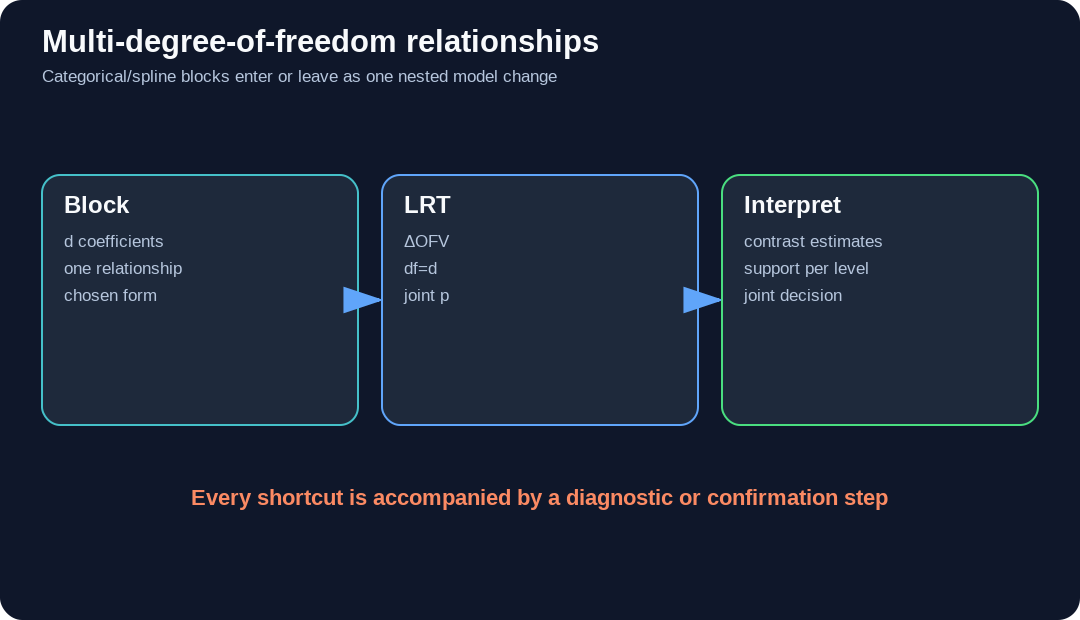
A relationship can contain more than one coefficient. A categorical covariate with several non-reference levels usually enters or leaves as a joint block. A spline may use multiple basis coefficients. The LRT degrees of freedom must equal the number of free coefficients changed between the nested models, and the decision applies to the relationship block—not to a hand-picked significant contrast.
Joint testing protects the model hierarchy but can dilute evidence when one sparse level drives little information. Inspect counts and observations per subject/level, reference choice, contrast estimates, uncertainty, and extrapolation. Grouped or ordinal forms can reduce dimension only when scientifically defensible; they must not be chosen merely to obtain a smaller p-value.
After selection, report the joint ΔOFV/df/p-value and every component estimate with its interpretation. Validate that the generated draft control stream preserves the intended reference and coefficient block. Boundary or rank problems weaken the nominal chi-square calibration and should trigger sensitivity analysis.
Common mistakes
- Treating a stepwise p-value as clinical importance or causal proof.
- Reading a candidate comparison without its active model, convergence state, degrees of freedom, and exact threshold.
- Reporting only the terminal relationship list while discarding failed models, path decisions, configuration, and provenance.
Page checklist
- The scientific question, model identities, and comparison direction are explicit.
- Numerical validity is reviewed before interpreting statistical evidence.
- The result is linked to the complete trace and final joint-model diagnostics.