24.37 Worked posterior-stability run
The teaching truth is CL–WT 0.75, CL–EGFR 0.55, V–WT 1.0, and no SEX effects. The primary command used 60 complementary-pair replicates, two posterior draws, the three default learners, and seed 24048.
nlmx cov --model-dir documents/ch22/results/base_fit --run-stem run22 `
  --covariates "CL=WT,EGFR,SEX;V=WT,SEX" --method posterior `
  --replicates 60 --draws-per-resample 2 --seed 24048 `
  --write-subject-level --write-replicate-selections `
  -o documents/ch24/results/primary
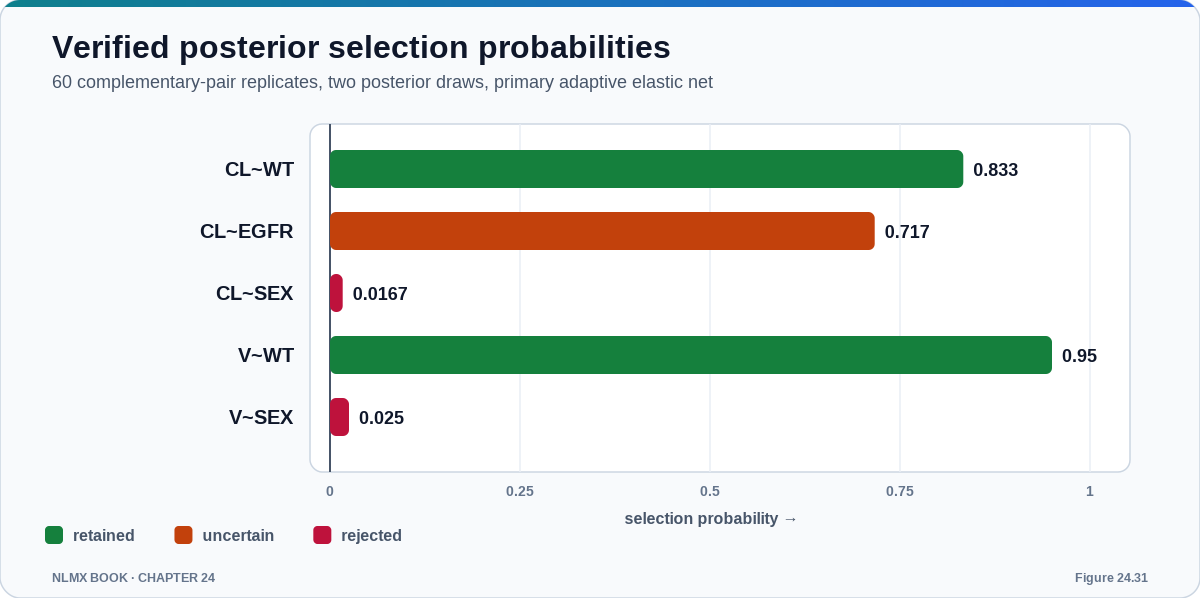
All 60 subjects used PHI means and ETC covariance. Moment error was below 0.5% and shrinkage below 3%. The engine scheduled 720 fits. V–WT probability was 0.950 and CL–WT 0.833, both retained with sign/agreement 1.00. CL–EGFR was 0.717 and uncertain. Both SEX effects were below 0.03 and rejected.
The PFER bound was 1.084 at 0.80, requiring about 0.817 to meet target 1.0; the warning is preserved. The joint final refit contained CL–WT 0.7506 and V–WT 1.009, OFV −1141.867.
Bootstrap resampling retained all three true effects. The all-six-learner run still left CL–EGFR uncertain at 0.767. These variants show design sensitivity, not a ranking of methods. Sixty replicates are illustrative; production work needs more.
Common mistakes
- Treating 60 replicates as definitive calibration.
- Ignoring the PFER warning.
- Calling CL–EGFR rejected.
- Reporting two-stage coefficients instead of final-refit values.
- Selecting bootstrap because it recovered known truth.
Checklist
- Reproduce version, inputs, command, and seed.
- Verify posterior source/moment diagnostics.
- Review schedule, failures, probabilities, gates, and PFER.
- Compare variants as sensitivity analyses.
- Confirm with SCM and full diagnostics.
Further reading
Open the primary report, jsonvariant summary, and csvprimary stability CSV.