19.11 Step-size schedule
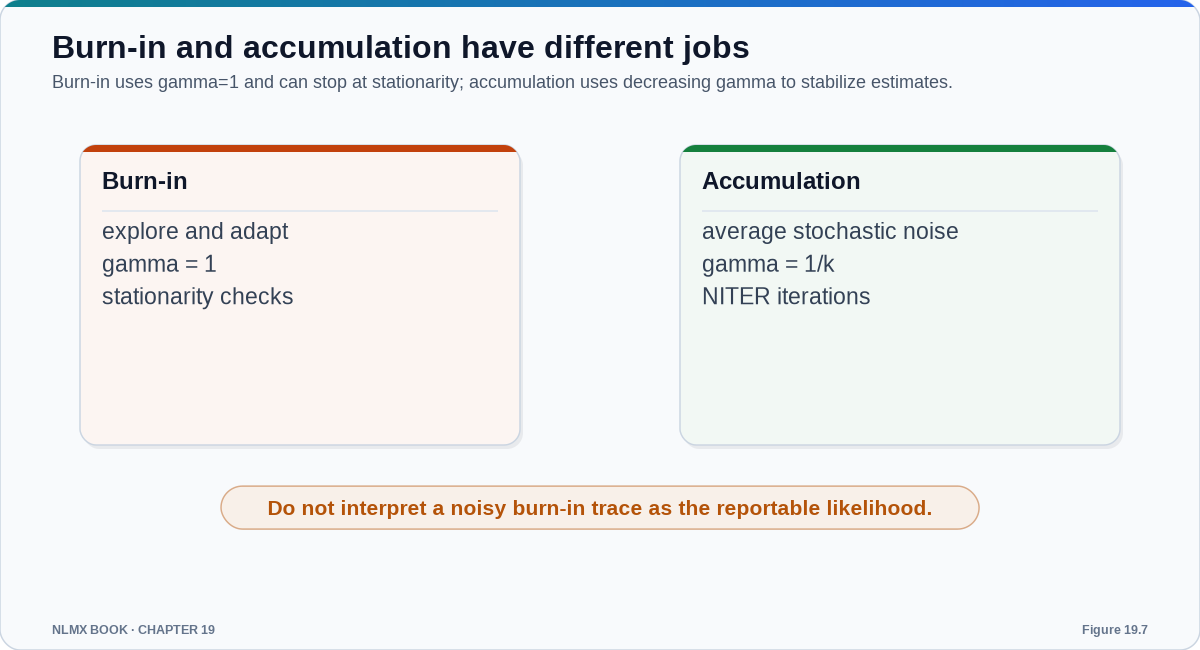
SAEM uses \(\gamma=1\) during burn-in and \(\gamma=1/k'\) during accumulation, where \(k'=1,2,...\) restarts at the accumulation phase. Burn-in prioritizes movement; accumulation prioritizes averaging.
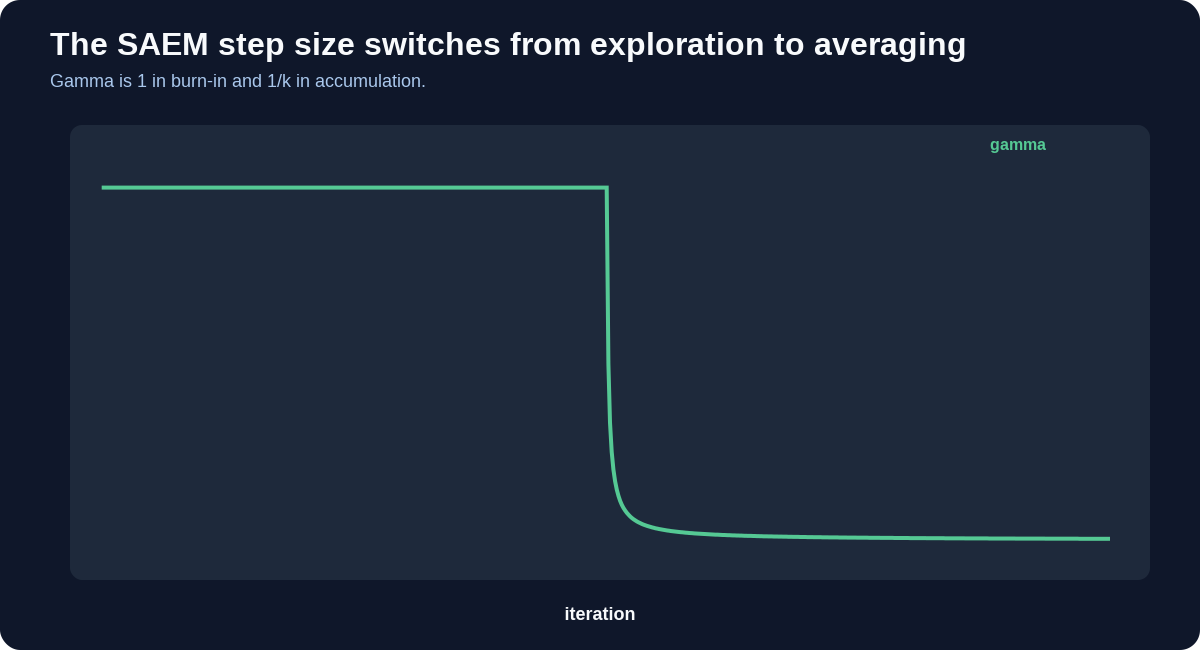
At first accumulation iteration gamma is one, so the statistic resets to that batch; later contributions shrink harmonically. This Robbins–Monro schedule has decreasing steps whose sum diverges while squared steps converge, supporting stochastic convergence under assumptions.
Too-short accumulation leaves Monte Carlo variability. Extending burn-in does not substitute for accumulation, and extending accumulation cannot repair nonstationary/mis-mixed chains.
Practical interpretation
List gamma for the first ten accumulation iterations: 1, 1/2, 1/3, and so on. The first batch has large influence, but later harmonic updates make S equal the average of all accumulation batches under the simple recursion. Unit-test the phase boundary because an off-by-one error changes every weight. Plot gamma on a log scale to make the long tail visible.
When evaluating custom schedules, state the stochastic-approximation conditions and validation evidence. Do not change gamma merely to smooth a plot.
The decreasing schedule also means late corrections are slow. If burn-in ends prematurely in the wrong region, accumulation may appear stable because gamma is small. This is why stationarity and mixing must be established before the phase transition, not inferred afterward from smoothness.
Archive the actual schedule.
Common mistakes
Do not continue burn-in iteration numbering inside (1/k'), average all burn-in samples into final statistics, or judge stability from gamma alone.
Checklist
- Verify phase boundary and k′ reset.
- Store gamma in traces.
- Separate burn-in and accumulation diagnostics.
- Extend the correct phase.
- Test deterministic schedule generation.
Further reading
See burn-in controls and accumulation.