Complete reporting and publication checklist
A complete methods section states nlmx/version, fitted model/run, estimation and covariance source, data/subjects, parameters/covariates, references, values/quantiles/levels/scenarios, uncertainty source/count/seed/CI, BSV percentile, inverse assumptions, reference band, and all exposure source/regimen/grid/bin/reference settings.
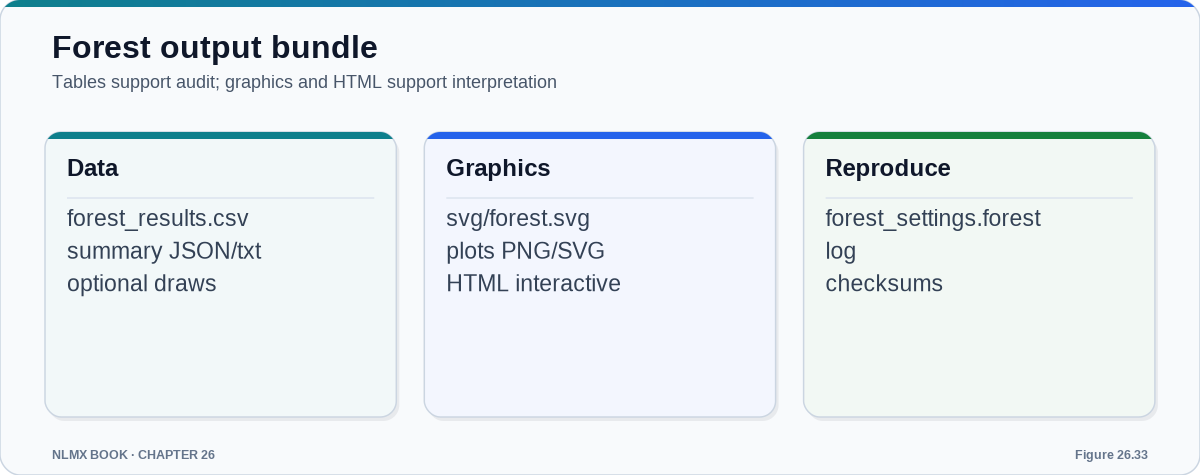
Results should give ratios and intervals—not only classifications—and identify outside/overlap/within logic, omitted no-effect rows, extrapolations, shrinkage, sparse groups, and scenario support. Separate parameter uncertainty, BSV, and subject-bootstrap intervals. Link every figure to forest_results.csv and resolved settings.
Before publication, verify model diagnostics and external confirmation, clinical interpretation, units/labels, accessible colors, final physical dimensions, unclipped arrows/text, caption completeness, checksum integrity, and reproducible commands. A reviewer should be able to regenerate the exact table and plot without guessing any denominator or regimen.
Common mistakes
- Treating a forest ratio or reference-band class as covariate-selection evidence, causality, or an automatic dosing recommendation.
- Omitting the reference subject, uncertainty source, regimen, subgroup denominator, data support, or fitted-model diagnostics.
- Confusing parameter-uncertainty intervals, BSV ranges, and subject-bootstrap intervals because they share one graphic.
Page checklist
- The numerator, denominator, fitted model, covariate settings, and units are explicit.
- The interval source and clinical meaning are distinguished from BSV and selection uncertainty.
- Tables, resolved settings, commands, diagnostics, limitations, and confirmation evidence are retained.