32.24 Reporting, validation, and the final trust checklist
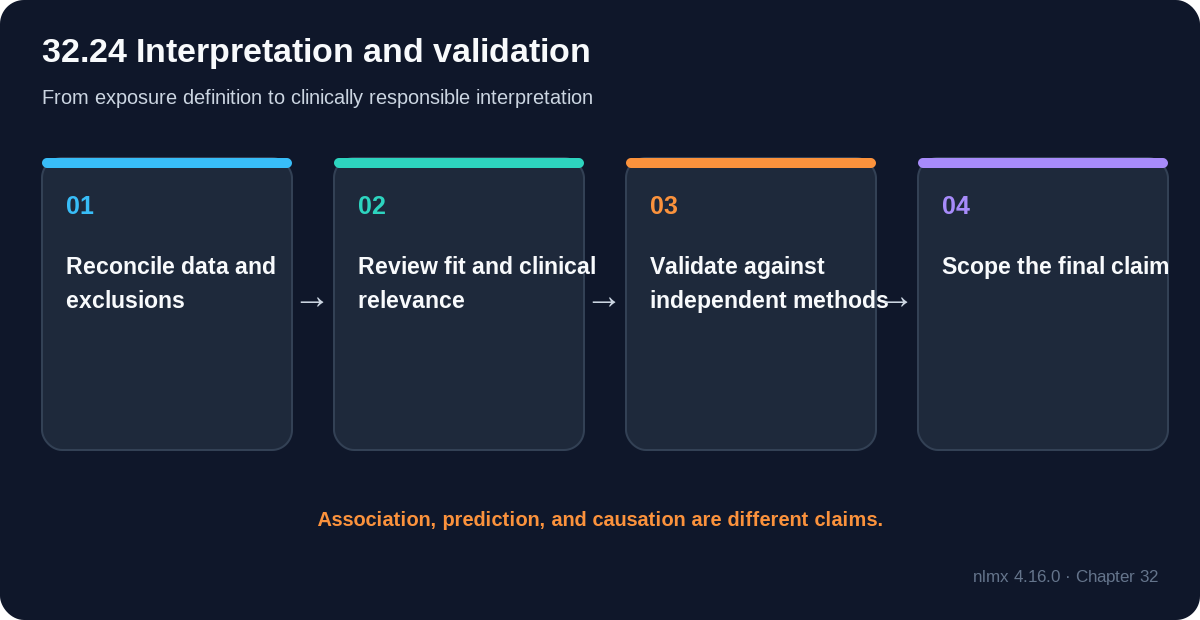
A defensible E–R report connects data provenance, estimand, model set, exclusions, parameter/effect uncertainty, diagnostics, clinical relevance, confounding limits, and validation. Numerical reproducibility is necessary but does not establish causal truth or external transportability.
Core concepts
- Reconcile input rows, subjects, placebo, active zeros, missingness, category counts, events, visits, and every exclusion reason.
- Validate formulas and representative results against independent software with matched conventions for links, ties, intervals, offsets, and criteria.
- Separate prespecified primary analysis, sensitivity analyses, and exploration.
Keep five layers separate: the dose assignment, the individual exposure, the endpoint definition, the statistical estimand, and the clinical decision. A fitted curve connects exposure and endpoint within the analysed data; it does not automatically identify the effect of changing dose or exposure in another population.
Worked interpretation
A conclusion should name endpoint, exposure metric/window, population, model/adjustment, exposure contrast, effect with interval, observed range, and causal limitation.
A reproducible review package
The package should allow an independent reviewer to reconstruct who entered each analysis, how every variable was derived, which settings were resolved, why models were eligible or rejected, and how each conclusion maps to an output. Include immutable input identifiers, data dictionary, derivation code, analysis specification, executable version, complete command/settings, logs, tabular outputs, plots, seeds, checksums, and reviewer decisions.
Use a result table with endpoint/estimand, population, exposure metric and window, model/link, adjustment, n and information count, contrast, estimate and interval, fit/diagnostics, sensitivity, and interpretation. Report failed and singular models alongside successful ones. Label exploratory work clearly and distinguish numerical reproducibility, implementation validation, scientific validity, and causal validity.
For cross-software validation, freeze a dataset and match parameterisation, likelihood constants, link sign, category ordering, ties, offsets, zero handling, estimation tolerances, covariance method, and interval type. Set acceptance tolerances before comparing. A final conclusion should be no stronger than the weakest supported layer: correct computation does not make a confounded association causal or an extrapolated curve clinically reliable.
For a novice, translate every coefficient back to the endpoint scale. Name the starting exposure, ending exposure, predicted outcome at both, contrast, interval, and observed support. For categorical or survival endpoints, also show absolute probabilities or survival estimates because odds and hazard ratios can be hard to interpret clinically.
Quality control and scientific review
Archive settings, data derivations, code/version, outputs, checksums, plots, model-selection decisions, failed fits, and reviewer conclusions.
Review sample size alone only after checking events, category cells, visit counts, placebo support, exposure overlap, exclusions, and missingness. A statistically precise curve can still be clinically irrelevant, confounded, extrapolated, or based on an endpoint definition that does not match the intended estimand.
Common mistakes
- Reporting only the best curve
- Generalising beyond exposure overlap or studied population
- Treating a significant exposure term as proof that the selected shape or causal story is correct
Evidence to retain
- exposure definition, window, units, derivation, estimation uncertainty, and distribution by arm;
- endpoint derivation, time origin/visit, analysis population, missing/censoring rules, and exclusions;
- candidate models, covariate rationale, contrasts, selection criterion, diagnostics, failed/unstable fits;
- effect estimates with intervals, observed range, sensitivity analyses, software version, settings, and checksums.
Navigation
See the previous page, next page, and model and estimand catalogue.