21.18 Identifiability, boundaries, and condition diagnostics
Visual goodness of fit cannot establish parameter identifiability. Different parameter combinations can generate nearly identical predictions over the observed design. Evidence of weak identification includes large RSE, strong parameter correlation, high condition number, boundary estimates, flat profiles, unstable multi-start solutions, high shrinkage, or strong EBE correlation.
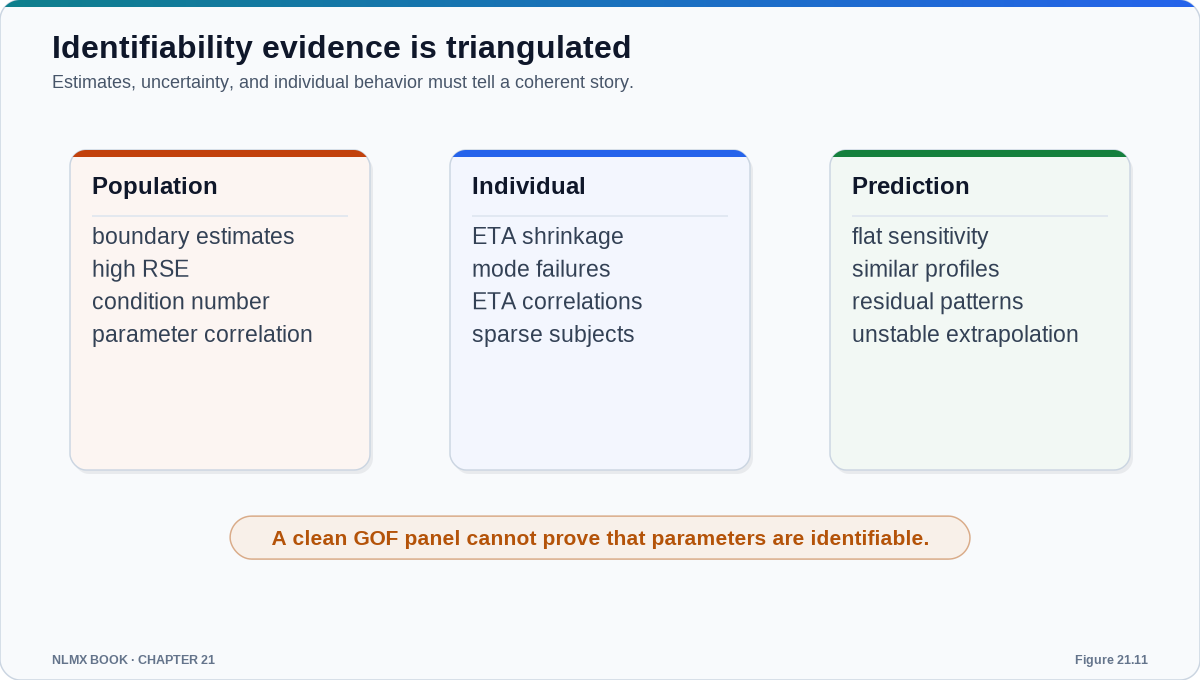
nlmx flags THETAs near declared bounds, OMEGA/SIGMA variances near zero relative to their initials, and covariance elements implying correlation near ±1. The covariance report provides a correlation-matrix condition number and, when relevant, a value excluding near-boundary parameters. The latter helps distinguish a localized boundary problem from broader ill-conditioning.
The Chapter 20 example converges and has acceptable GOF plots, yet its additive residual SD approaches zero. Its sandwich covariance condition number is about 24.1 and falls to about 12.4 without the boundary parameter. The correct conclusion is not “everything is fine” or “the whole model failed.” The additive component is weakly supported; the remaining parameter system appears better conditioned. A reduced proportional-error model and sensitivity analysis are appropriate.
Boundary inference is nonstandard. Symmetric Wald intervals can cross impossible values, and ordinary likelihood-ratio reference distributions may not apply. State the boundary, avoid overinterpreting its SE, and evaluate scientific consequences.
Where the analysis decision depends on a weak parameter, consider profile-based, bootstrap, simulation, or design-sensitivity evidence appropriate to the problem rather than relying exclusively on local Wald uncertainty.
Common mistakes
- Declaring parameters identifiable from clean residual plots.
- Reporting a boundary Wald interval without qualification.
- Treating one condition-number threshold as universal.
- Fixing a weak parameter only to make covariance succeed.
- Ignoring multi-start or reduced-model sensitivity.
Checklist
- Review boundaries, RSEs, correlations, and condition numbers.
- Compare conditioning with boundary parameters excluded.
- Examine shrinkage and EBE relationships.
- Test reduced and alternative parameterizations.
- Report uncertainty limitations and decision impact.
Further reading
See Chapter 20’s covariance failure guide, local optima, and Chapter 18 covariance theory.