18.20 Cholesky parameterization of OMEGA and SIGMA
A covariance matrix must be symmetric positive definite. nlmx represents each estimated block as \(LL^{\mathsf T}\), where \(L\) is lower triangular and its diagonal is optimized on a log scale. Any finite internal vector therefore decodes to positive diagonal factors and a valid covariance matrix.
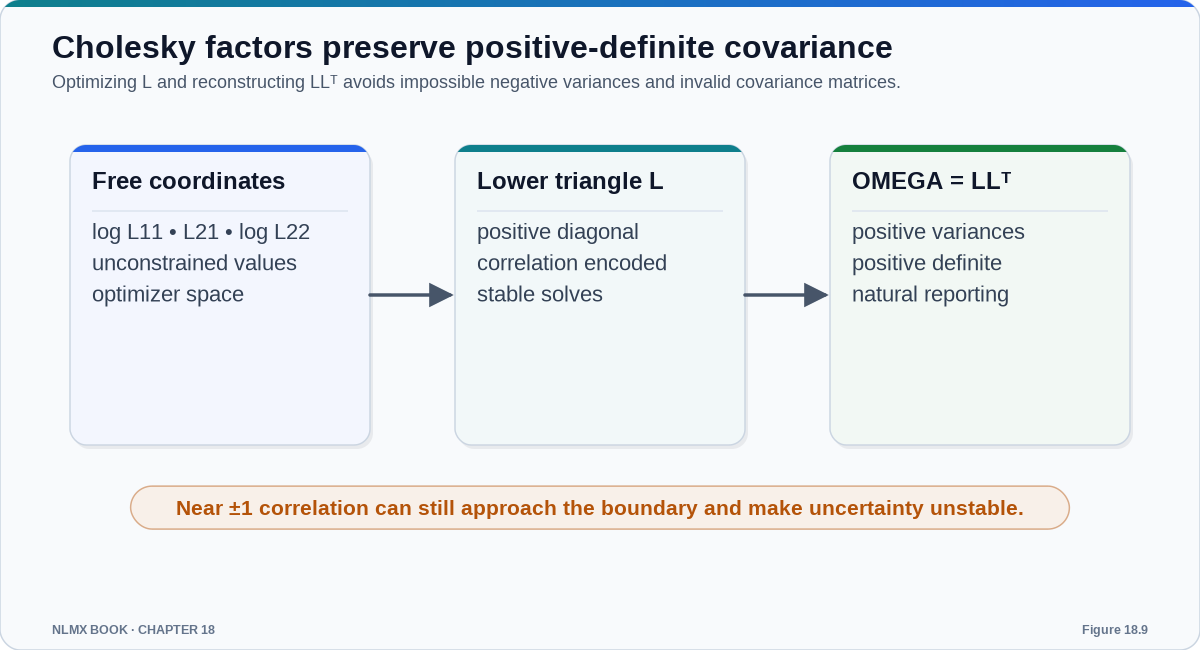
Off-diagonal Cholesky elements are not reported covariances; reconstruction produces natural OMEGA/SIGMA elements. A full block with dimension \(q\) has (q(q+1)/2) free elements unless some are fixed/tied.
Positive definiteness does not guarantee identifiability. Correlation can approach ±1, making the matrix nearly singular and uncertainty unstable. nlmx flags implied correlations of magnitude at least 0.99 as near boundary.
Practical interpretation
For a 2×2 block, choose positive \(L_{11},L_{22}\) and any \(L_{21}\), multiply \(LL^{\mathsf T}\), and calculate the implied correlation. Increase |\(L_{21}\)| while holding diagonals. The covariance remains positive definite, yet correlation can approach a boundary and conditioning deteriorates. This separates mathematical validity from practical estimability.
When comparing outputs, map the reported lower triangle into a full symmetric matrix and verify \(v^{\mathsf T}\Omega v>0\) for representative vectors. Then compare variances, correlations and eigenvalues—not internal Cholesky coordinates.
Block size also affects computational burden and parameter count. Add covariance terms only when scientific rationale and design information support them; an unconstrained valid block can still overfit.
Document the ETA ordering explicitly.
Common mistakes
Do not interpret Cholesky elements scientifically, count every displayed symmetric cell twice, or assume a valid decoded matrix has good conditioning.
Checklist
- Count lower-triangle free elements.
- Decode to variances/covariances before reporting.
- Calculate correlations and eigenvalues.
- Review near-singular blocks.
- Map tied and fixed elements.
Further reading
See OMEGA, covariance-step conditioning, and source-facing Chapter 20.