24.13 Posterior draws versus posterior means
--response posterior-draws samples ETAs from each subject posterior for every scheduled draw. This propagates individual uncertainty into the learner and is the default. posterior-mean uses mᵢ directly, reducing Monte Carlo variation and cost but treating the posterior location as the response.
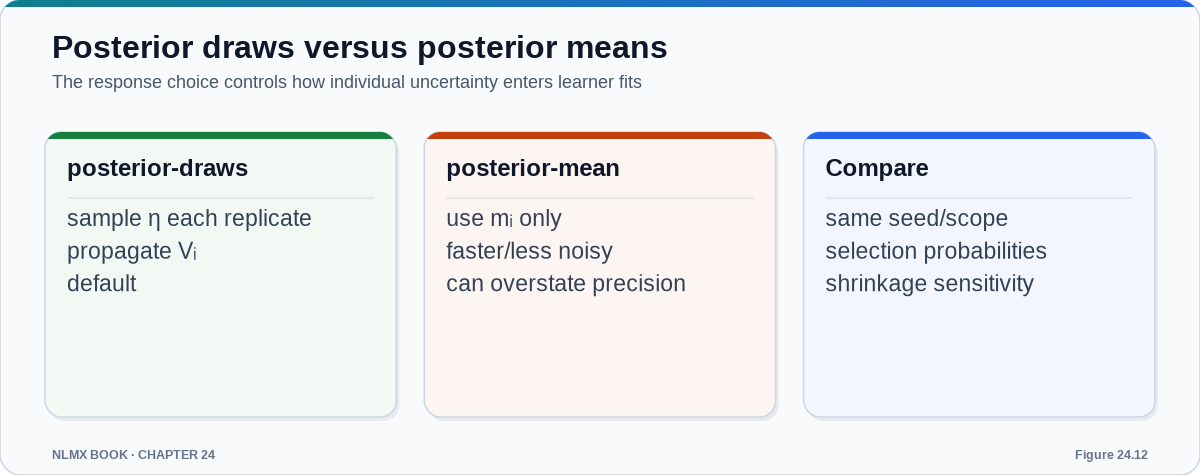
Posterior means can produce more stable-looking selection when shrinkage is modest, but can overstate precision and attenuate effects when shrinkage is high. In a sensitivity comparison, keep resampling, learners, seed, thresholds, and scope fixed. Interpret differences as uncertainty sensitivity, not as permission to select the more favorable response.
Median two-stage coefficients from either response are screening summaries. The final joint refit provides model coefficients.
Common mistakes
- Calling posterior-mean results uncertainty-adjusted.
- Comparing response variants with different replicate schedules.
- Treating Monte Carlo variability as model uncertainty.
- Reporting median learner coefficient as final ML estimate.
- Choosing means after draws give an uncertain result.
Checklist
- Use posterior draws as the qualified primary response.
- Record draws per resample and draw method.
- Compare posterior means as a labeled sensitivity.
- Review shrinkage and selection-probability changes.
- Use final refit for effect interpretation.
Further reading
See draw methods, worked variants, and point-EBE bias.