Operating characteristics and acceptance matrices
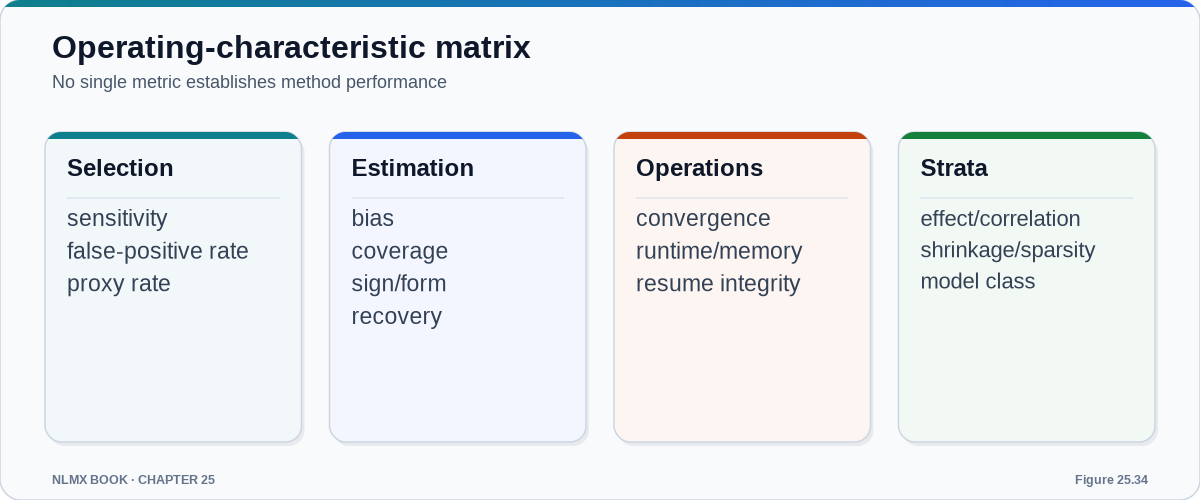
Selection performance requires multiple metrics: relationship and cluster sensitivity, false-positive rate, proxy-selection rate, sign/form recovery, endpoint concordance, and uncertainty frequency. Estimation performance requires coefficient bias, interval coverage, OFV and prediction differences, and clinical-effect accuracy. Operations require convergence/failure rates, runtime, memory, disk, determinism, and resume integrity.
Stratify metrics by model class and difficulty. An average can hide failure in high-shrinkage or rare-category designs. Predefine acceptance thresholds and confidence intervals, reference engine/version, treatment of failed fits, and whether proxy recovery counts as success.
Maintain a versioned validation matrix. Every release should rerun frozen reference datasets and investigate regressions rather than simply updating baselines. Matching an endpoint is insufficient if paths, failures, coefficients, or provenance differ materially.
Common mistakes
- Changing the scientific question after seeing the result while presenting it as the original run.
- Reading one engine's summary without checking its prerequisites, failures, normalized settings, and fitted endpoint.
- Treating a generated draft, comparison label, or completed checkpoint as a substitute for model diagnostics and reference-software confirmation.
Page checklist
- The exact command, version, inputs, resolved settings, and output directory are identifiable.
- Engine-specific evidence is interpreted on its own scale before cross-method comparison.
- Recovery state, final refit, diagnostics, and remaining confirmation work are explicit.