14.15 Clearance and terminal volume by route
Clearance and terminal volume combine dose, exposure, and terminal slope. Their names must reflect the administration route because an extravascular dose is not generally fully available to systemic circulation.
For intravenous administration:
CL = effective dose / AUCinf
Vz = effective dose / (lambda_z × AUCinf) = CL / lambda_z
For oral or other extravascular administration, nlmx reports apparent quantities:
CL/F  = effective dose / AUCinf
Vz/F  = effective dose / (lambda_z × AUCinf)
F is absolute bioavailability. Unless F is independently known, CL and F cannot be separated from an oral profile, nor can Vz and F. Calling CL/F simply “clearance” hides an important assumption.
Effective dose and units
The effective dose is the recorded dose after applying any configured dose factor. nlmx carries unit labels but does not infer or perform arbitrary concentration-dose unit conversions. For example, a dose in mg and AUC in ng·h/mL require a factor consistent with 1 mg = 1,000,000 ng and 1 L = 1,000 mL; otherwise a numerically calculated clearance can be off by orders of magnitude while still looking tidy. Unit reconciliation is an analysis responsibility.
Vz is a terminal or area volume, not a measured anatomical space. It can be much larger than body volume because it summarizes proportionality between amount and terminal concentration under the model-free derivation. It is distinct from steady-state volume, Vss.
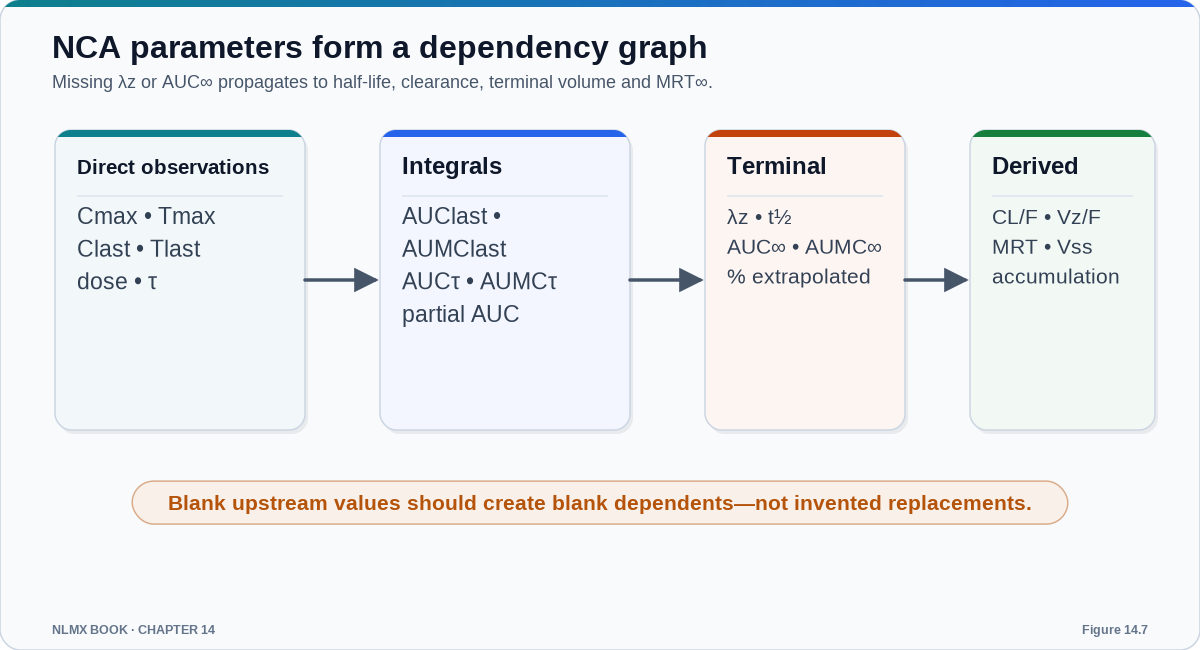
Every parameter inherits its upstream dependencies. If lambda_z is absent, Vz or Vz/F is absent. If AUCinf fails an extrapolation rule, clearance and volume based on AUCinf should be flagged or omitted consistently. The parameter-dependency diagram is therefore also a review map.
Common mistakes
- Removing
/Ffrom an extravascular parameter name. - Assuming nlmx automatically converts dose and concentration units.
- Interpreting Vz as a physiological compartment volume.
- Retaining CL or Vz after rejecting the AUCinf on which it depends.
Checklist
- Confirm route and parameter naming.
- Verify dose, dose factor, AUC units, and desired output units.
- Trace AUCinf and lambda_z diagnostics downstream.
- Distinguish Vz from Vss.
- State whether bioavailability is known or unidentified.
Further reading
Continue with AUMC, MRT, and Vss, units and dose factors, and bioavailability comparisons.