39.17 Troubleshooting settings, command-line precedence, and versions
What you will learn
- Reconstruct the effective configuration
- Detect version/template drift
- Change one key or override at a time
Prerequisites: Chapter 36 exit-code reference, Chapter 38 output completion, and the Chapter 39 overview.
This page describes nlmx 4.16.2. Troubleshooting must preserve the failed attempt: keep its exact command, working directory, log, resolved settings, input/model identities, partial outputs, and process exit code. Correct one causal condition at a time and compare the new evidence with the failed run. Never convert a nonzero exit into success in a wrapper, and never interpret exit 0 as scientific acceptance without the command-native verdict.
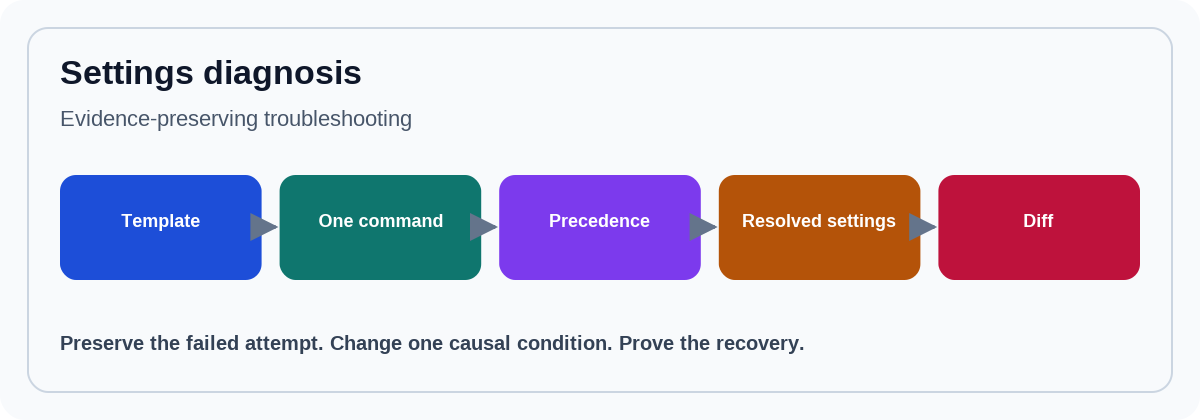
The file you read is not always the configuration the command executed. Defaults, control-stream options, command-specific settings, and CLI overrides are resolved by documented precedence. Preserve the original settings, exact argv, generated/resolved settings artifact, and version. If a value surprises you, trace it through every layer.
Start from the same executable's template/schema and help. Compare extensions, dotted keys, types, and defaults. Remove no unknown key until you know whether it carried a material older-version behavior. Check duplicate CLI options, Boolean negations (--plots/--no-plots), repeatable arrays, and command mini-languages.
Create a minimal copy that keeps the same input and one disputed setting. Use validate, inspect, --print-options, or generated templates where the command supports them. After correction, diff resolved settings rather than handwritten files only. A change in default caused by upgrade must be pinned explicitly if the prior behavior is required.
For regulated reuse, maintain versioned settings templates and migration tests. Reject unknown executable versions, archive template and schema hashes, and test a representative fixture. Do not let a pipeline automatically rewrite settings and proceed without review.
Page checklist
- Did you retain the exact exit code, stage, message, hint, log, and partial output?
- Did you identify one causal layer before changing anything?
- Is the recovery a new, traceable attempt with the same intended estimand?
- Did you check command-native and scientific acceptance after process completion?
Navigation
See the previous page, next page, and complete error reference.