24.7 Laplace and conditional-Gaussian approximations
Configuration posterior.approximation accepts laplace or conditional_gaussian. Laplace uses the conditional mode and local Hessian of the subject log posterior, producing a normal approximation around the mode. Conditional Gaussian uses the supported conditional approximation for the model.
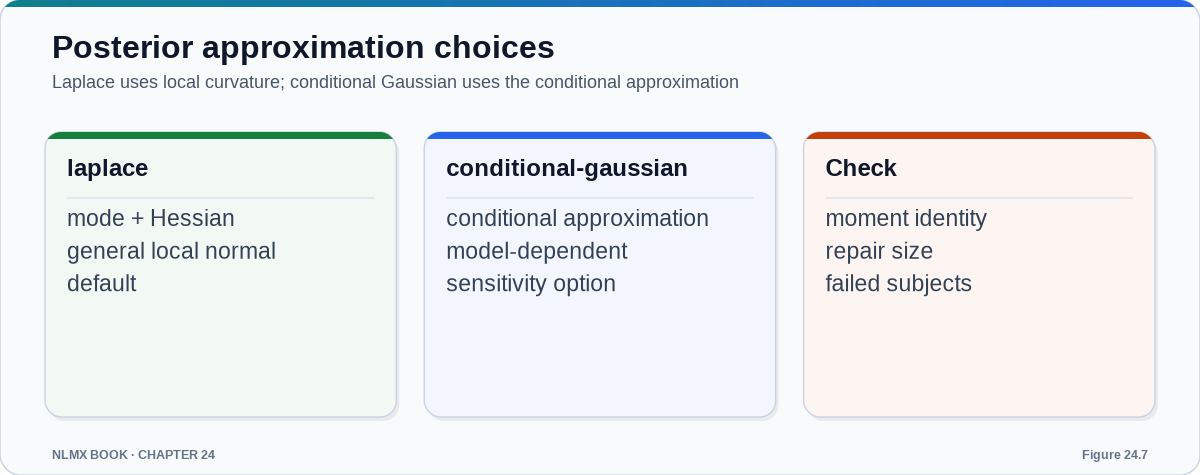
Both are approximations. Laplace can struggle with skewed, multimodal, boundary, or weakly identified posteriors. Conditional Gaussian may be efficient but depends on the model's local linear/normal behavior. Compare means, variances, moment error, repair frequency, and stability classifications rather than assuming one name is universally superior.
The approximation controls posterior reconstruction, not the final covariate-model refit. If the primary workflow uses external PHI/ETC for all subjects, the configured reconstruction approximation may be exercised only for gaps, but it should still be recorded.
Common mistakes
- Calling Laplace posterior sampling exact Bayesian inference.
- Assuming the setting is irrelevant because most subjects use PHI.
- Comparing approximation variants with different failed-subject handling.
- Ignoring skewness or boundaries.
- Reporting selection differences without posterior diagnostic differences.
Checklist
- Record the resolved posterior approximation.
- Inspect moment consistency and curvature repairs.
- Compare representative subjects where possible.
- Keep failure policy constant across sensitivity runs.
- Confirm final relationships in the population likelihood.
Further reading
Continue with repairs and failure policies and Chapter 18's Laplace discussion.