16.15 Units, scaling, and control-stream S lines
Autoinit must match the scale on which the target control stream computes concentrations. Use either an explicit scale expression or a dose/concentration unit pair.
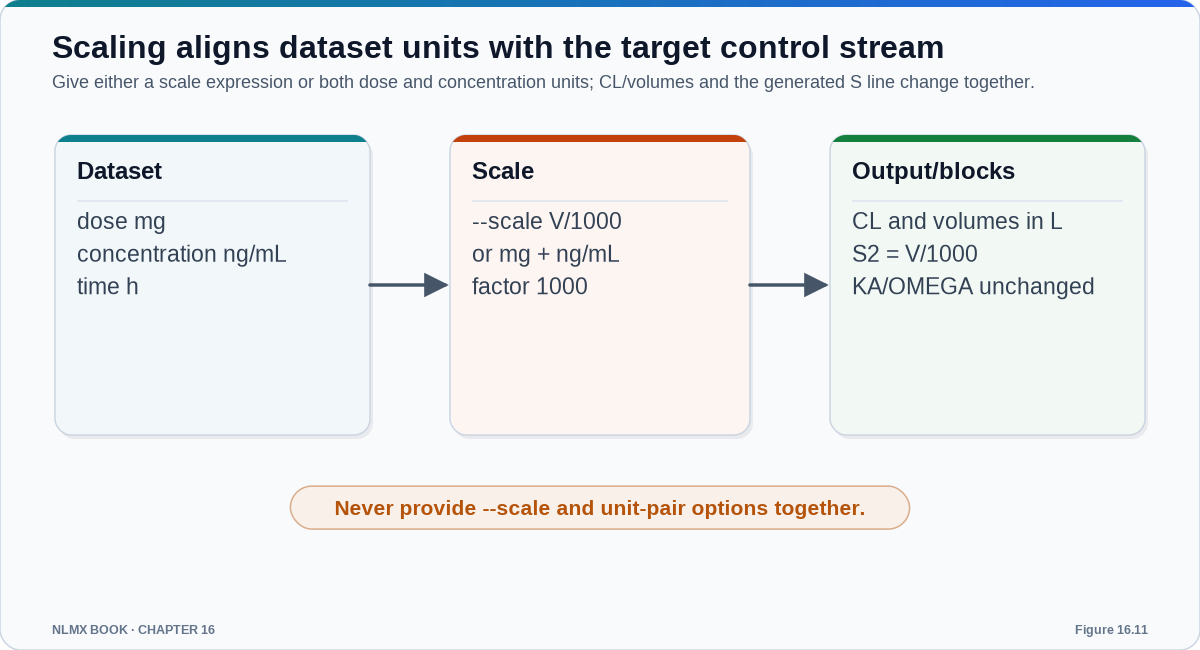
Explicit scale
--scale V means S=V. --scale V/1000 means the model divides V by 1000 in its S line; therefore autoinit multiplies CL and volume-like quantities by 1000 relative to raw dose/concentration ratios. V*1000 applies the reciprocal direction. A numeric divisor such as 1000 is also accepted.
The volume name in the expression is syntactic guidance: V2/1000 still identifies the same factor. Invalid, zero, negative, or nonfinite factors are rejected.
Unit-pair inference
--dose-unit mg --conc-unit ng/mL derives V/1000 so reported volumes/clearances are in L and L/time. Supported mass units are g, mg, ug/mcg, ng, and pg; volume units include L, dL, mL, and uL. Both units are required. Molar concentration needs molecular-weight handling upstream and an explicit scale.
Give either unit pair or scale, never both. Scaling affects CL, V, V1/V2/V3, Q and Q3. KA, ALAG, F1, OMEGA and residual-error magnitudes do not receive that multiplicative factor, although additive error remains on the concentration scale.
Generated blocks receive matching S lines. This coupling prevents values and model code from silently using different scales.
Common mistakes
- Using Chapter 15
dose_factorinstead of autoinit scale. - Providing only dose or concentration unit.
- Applying an upstream conversion and scale again.
- Copying values into a model with a different S convention.
Checklist
- Write the target concentration equation.
- Choose scale or complete unit pair.
- Verify a hand-calculated dose/AUC magnitude.
- Inspect generated S lines for every structure.
- Keep additive error in the correct concentration units.
Further reading
Use the scaled worked example, parameter sources, and Chapter 7's configuration guidance.